Victorian
Circa mid to late 19th century | England
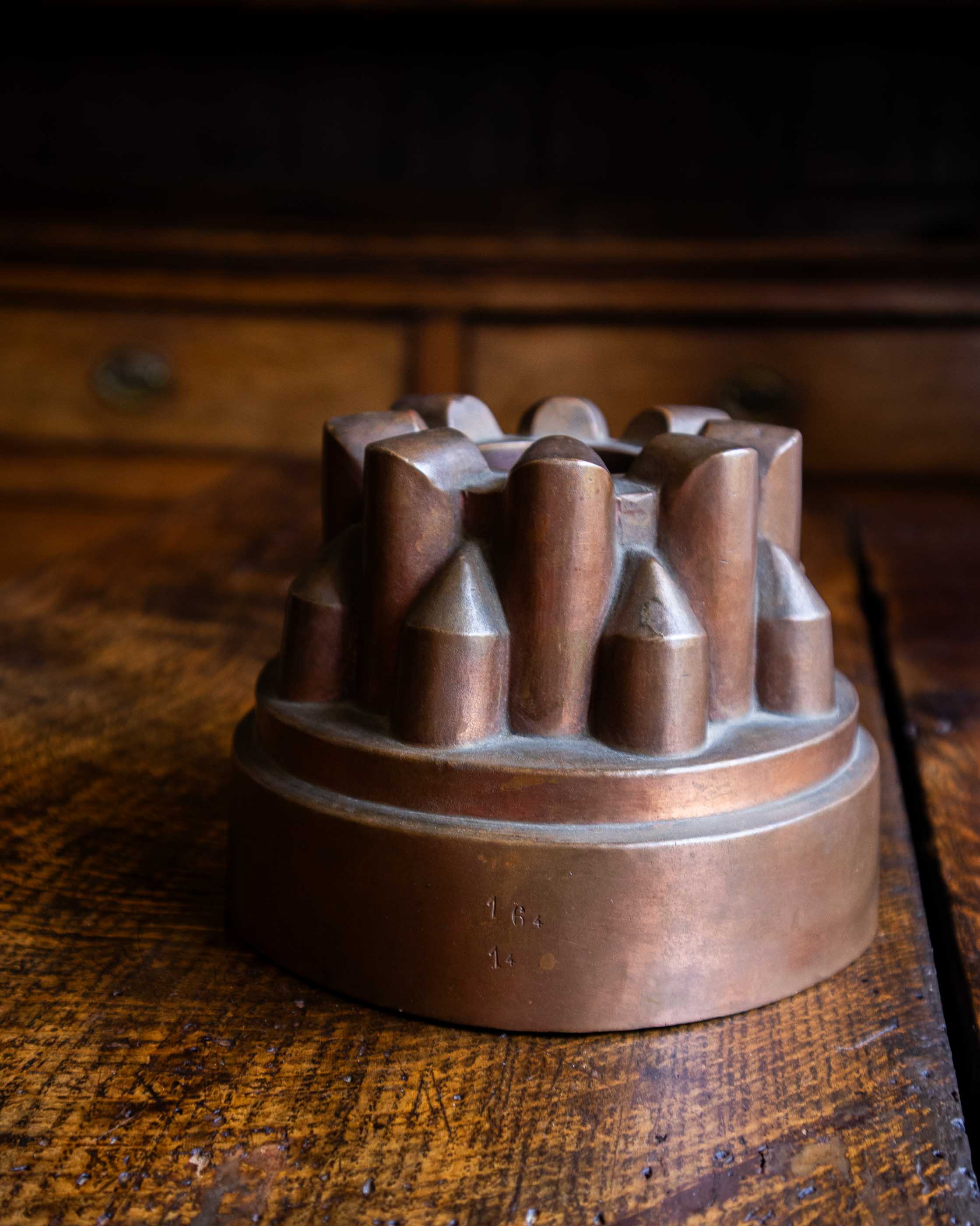
An antique copper jelly mould decorated with a design representing the turrets of a castle. Copper moulds became popular in the mid-nineteenth century following the Great Exhibition in 1851 (see The Gen).
DIMENSIONS: Diameter 14.3 cm, Height 10 cm.
SIGNATURES, MARKINGS & INSCRIPTIONS: Marked 164 and 14. Possibly made by Benham & Froud.
CONDITION: In very good condition, wear consistent with an antique age and use.
REFERENCES: See a group lot of similar Benham & Froud moulds that was auctioned at Christie’s on 24 May 2017, Lot 269.
All our antique copper comes in as found ‘unrestored’ condition with the years of history retained in the lovely patina created by surface marks made by ordinary kitchen use. The choice then becomes yours whether to have the item polished, or the tin relined, and a decorative item can once more become a treasured new kitchen utensil to be loved and used by a new gen. At times an item may already have been lovingly polished by a previous owner and the copper will show off its rosy glow. Whether polished or not, the patina adds to the history of the item and wonder of the stories it could tell.
~~~~~~~~~~~
THE GEN
“The Great Exhibition of 1851 worked wonders for the manufacturers of jelly moulds. Alcoholic drink was forbidden in the exhibition halls, but millions were instead introduced to the pleasures of fruit-flavoured jellies. These were more popular than ice-cream, largely because so many visitors had teeth that were sensitive to cold. Jelly moulds had first appeared for the few in the 18th century. Nearly all ironmongers stocked them in the post-1851 jelly craze.” (The Observer’s Book of Kitchen Antiques, John Woodforde, Fredrick Warne (Publishers) Ltd, 1982, p. 90)
~~~~~~~~~~~
Would you like to know more about this piece?
Make an enquiry via email here.