Victorian
Circa 1860–1900 | England
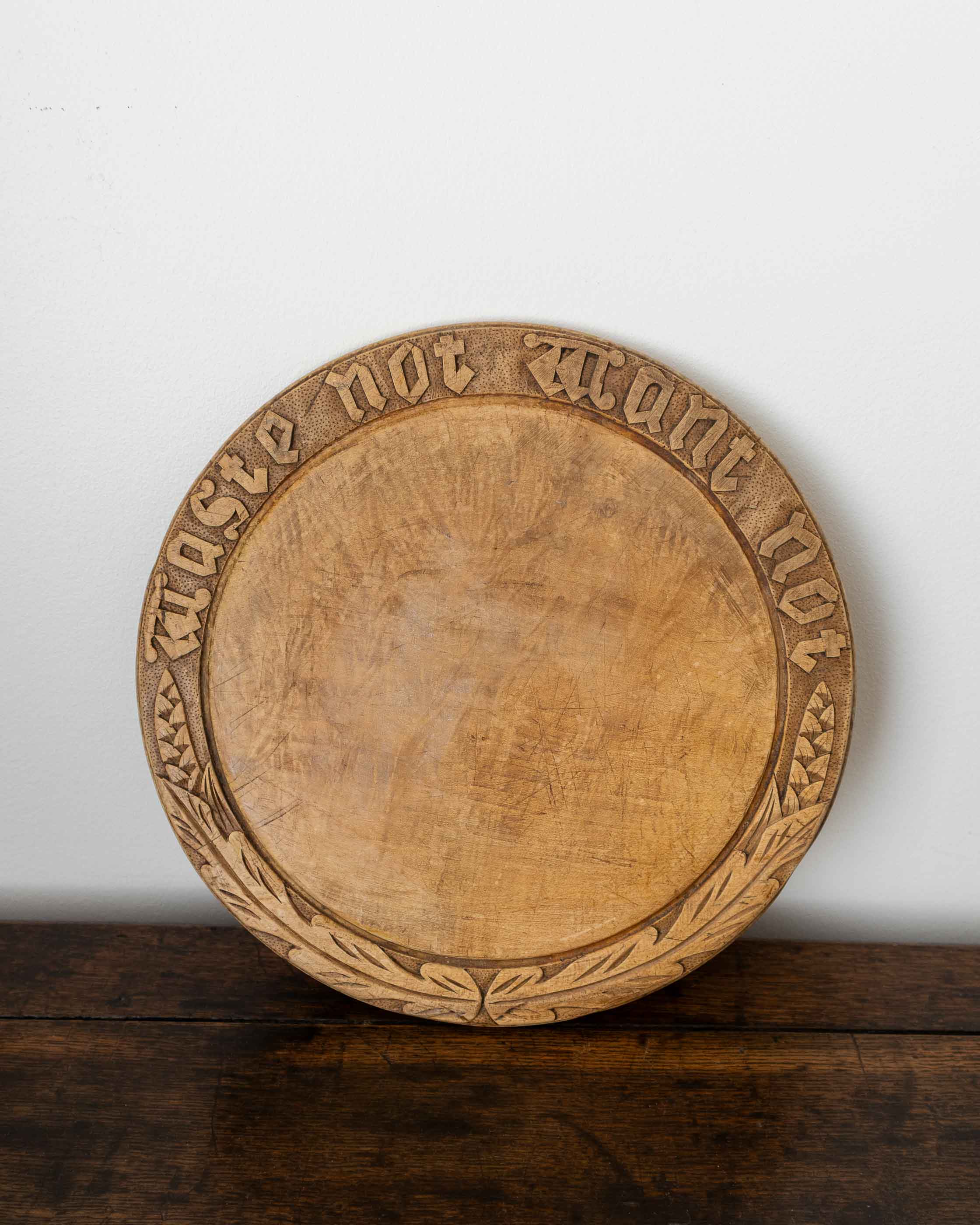
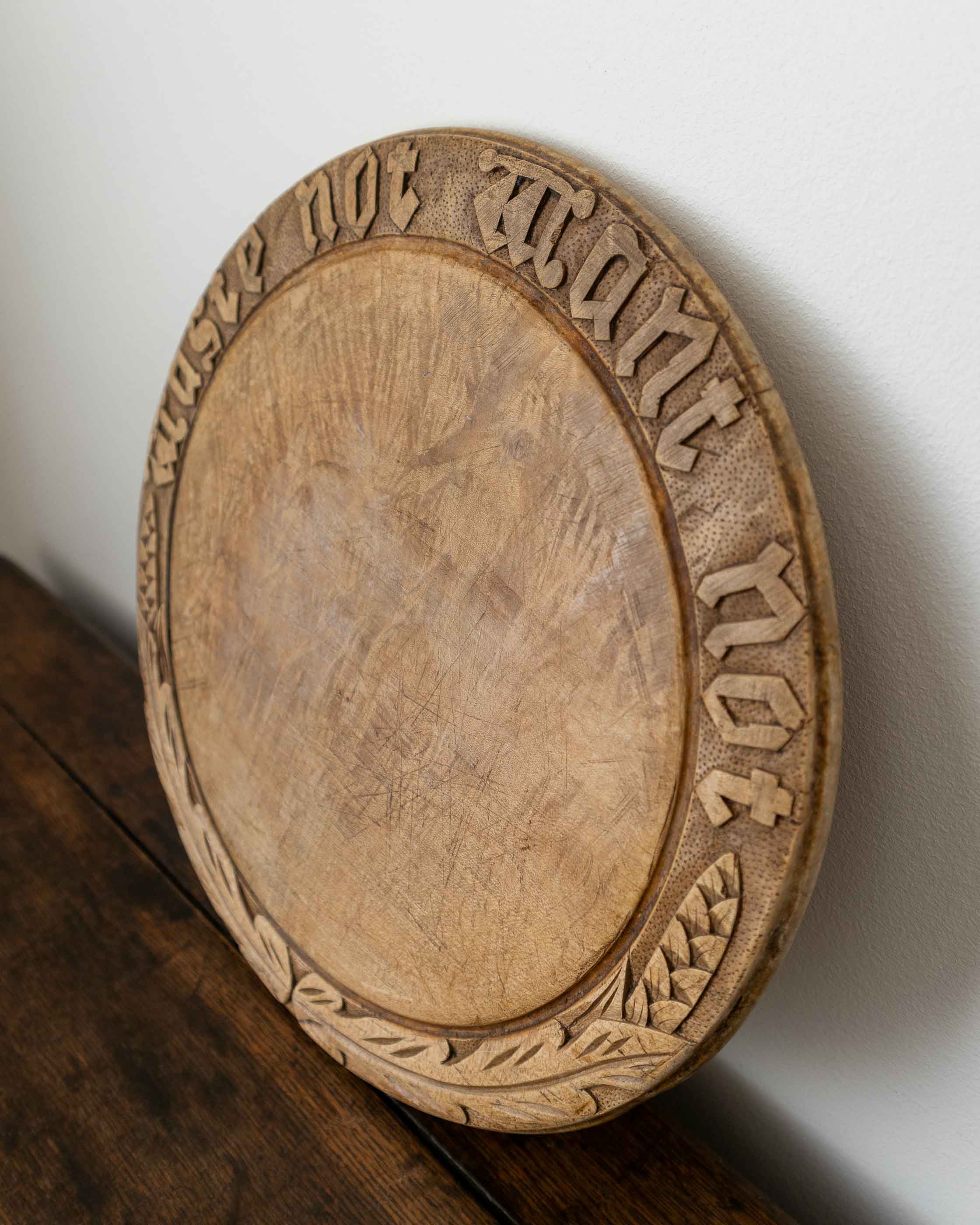
An exceptional Victorian carved wooden breadboard or “bread-platter” as it was known in Victorian times. The top border contains the motto “Waste Not Want Not” in gothic script, a term which was first carved on breadboards by William Gibbs Rogers of London (1792–1875), carver of commissioned breadboards to the aristocracy and gentry (see The Gen).
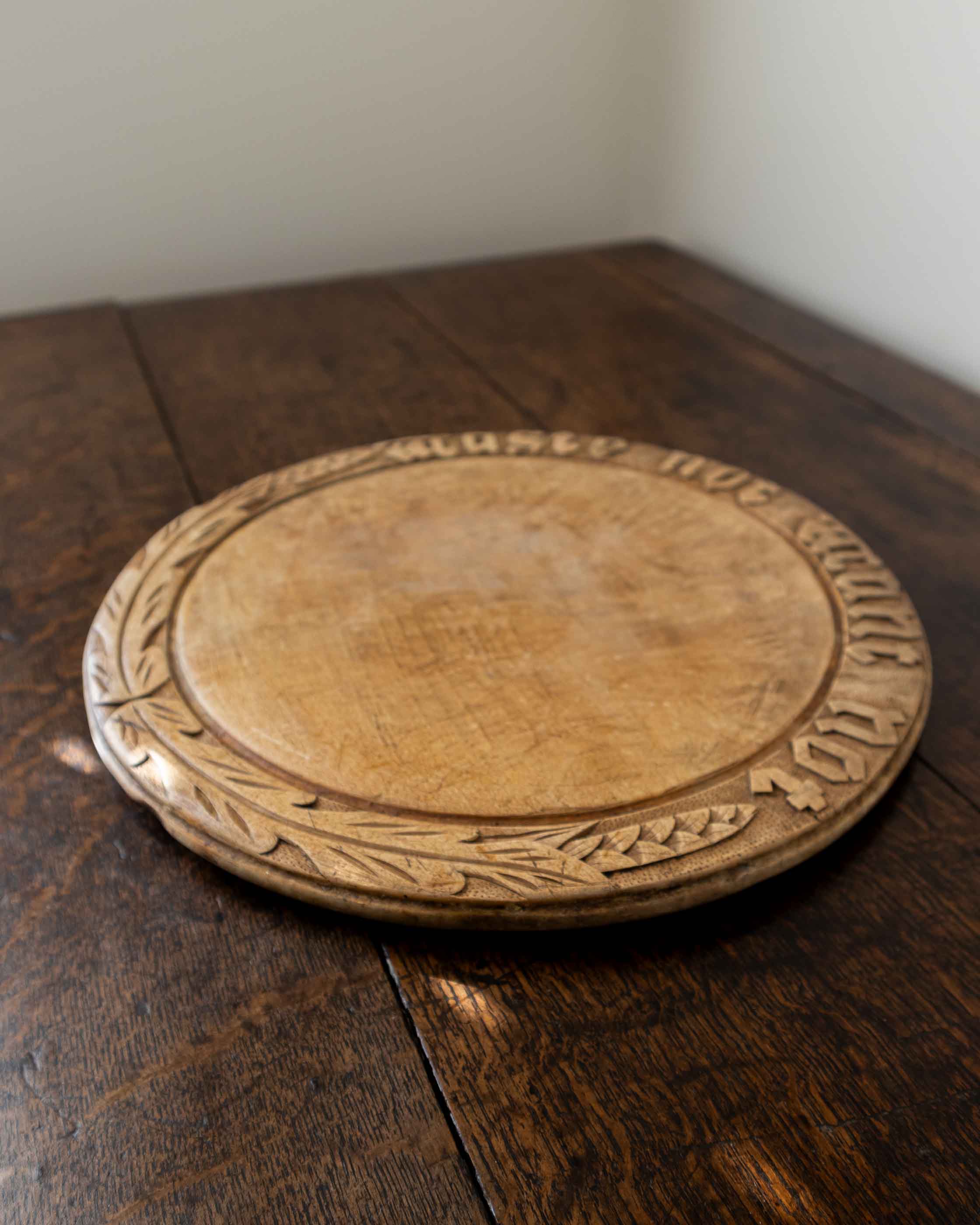
The antique carved breadboard has a symmetrical half bottom border of beautifully carved wheatsheaves. It has a lovely deep patina in the carving, particularly evident in the background of the border and the motto.
DIMENSIONS: Diameter 29 cm.
SIGNATURES, MARKINGS & INSCRIPTIONS: Whilst attribution of breadboards is difficult, there were three predominant carvers of such “bread-platters” during the Victorian era: the aforementioned William Gibbs Rogers of London, William Wing (and his sons) and Frederick William (F.W.) Dover, both of Sheffield. This breadboard is likely made by one of these makers or their sons.
CONDITION: In excellent condition, with wear commensurate with antique age and use of such a piece. The breadboard has a lovely patina evident through the untouched colour and wear, light knife marks and some scorch marks on the back. These all add to the history of the piece and wonder of the stories it could tell.
REFERENCES: For examples of similar antique breadboards with the “Waste Not Want Not” motto see Vintage Breadboards, Madeleine Neave, Prospect Books, 2019, pp 84–85, 208.
~~~~~~~~~~~
THE GEN
William Gibbs Rogers of London (1792–1875), carver to royalty and aristocracy, started carving beautiful, commissioned breadboards at some point between the 1830s and 1840s; subsequently his sons also became carvers of breadboards. From 1815, with the introduction of the Corn Laws, until 1846 the wealthy could afford to flaunt their access to bread so much so that it became almost a status symbol, hence the commissioning of personalised bread-platters from Rogers. “Some are encircled by such mottos as ‘Bread is the Staff of Life’, ‘Waste not, want not’, etc., in raised letters of old English character. Others are bordered only with groups of corn differently arranged. Many have been executed by the order of noblemen and gentlemen, when family mottos and crest have been substituted. The demand for these platters seems so large that it can scarcely be met so readily as might be wished, from the paucity of really competent operatives.” (The Art Union, Monthly Journal of the Arts 1848, Published for the Proprietors by Chapman & Hall, 186 Strand, p. 315)
~~~~~~~~~~~
Would you like to know more about this piece?
Make an enquiry via email here.