



Francis Roy Thompson (1896–1966)
Francis Roy Thompson (1896–1966)
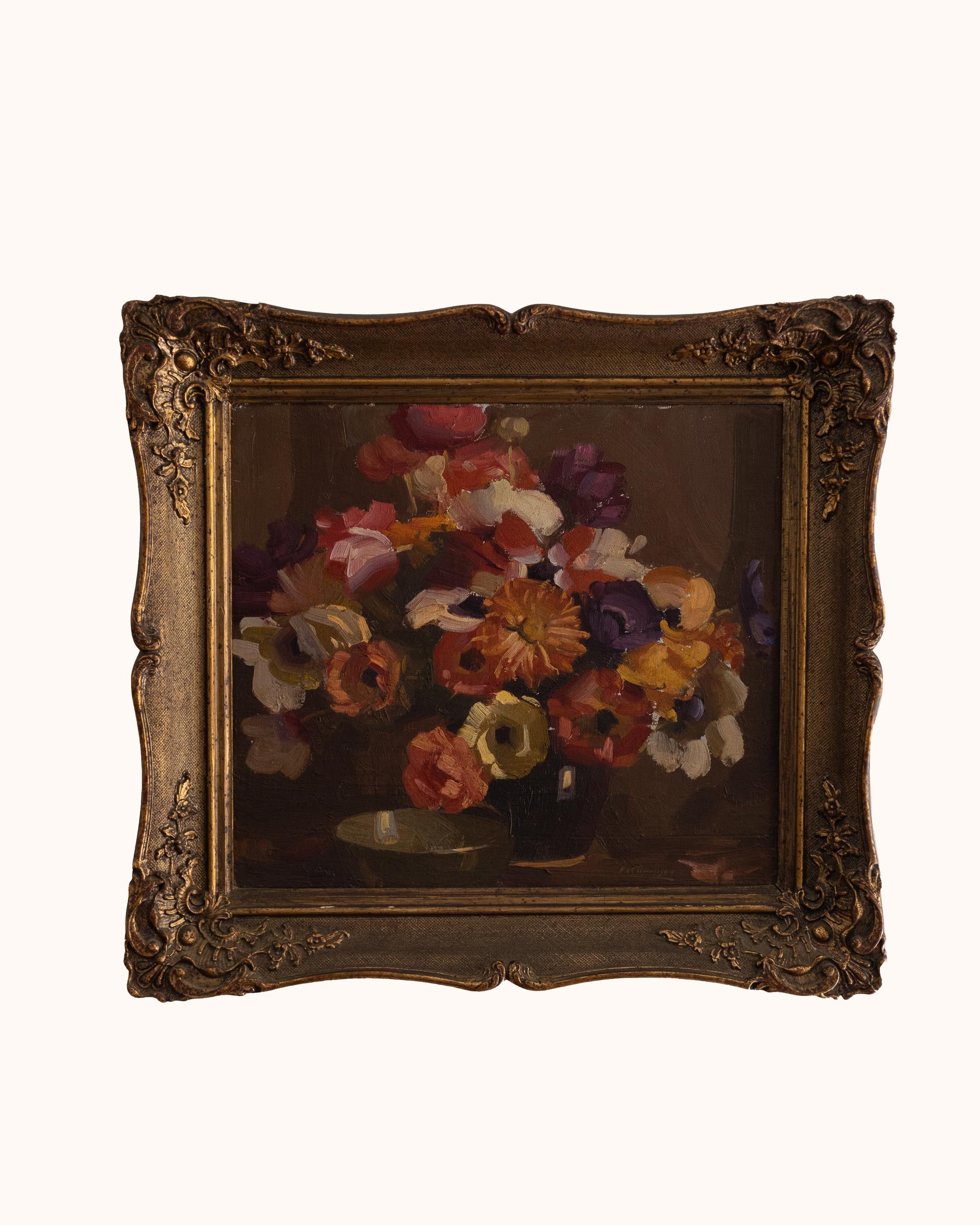
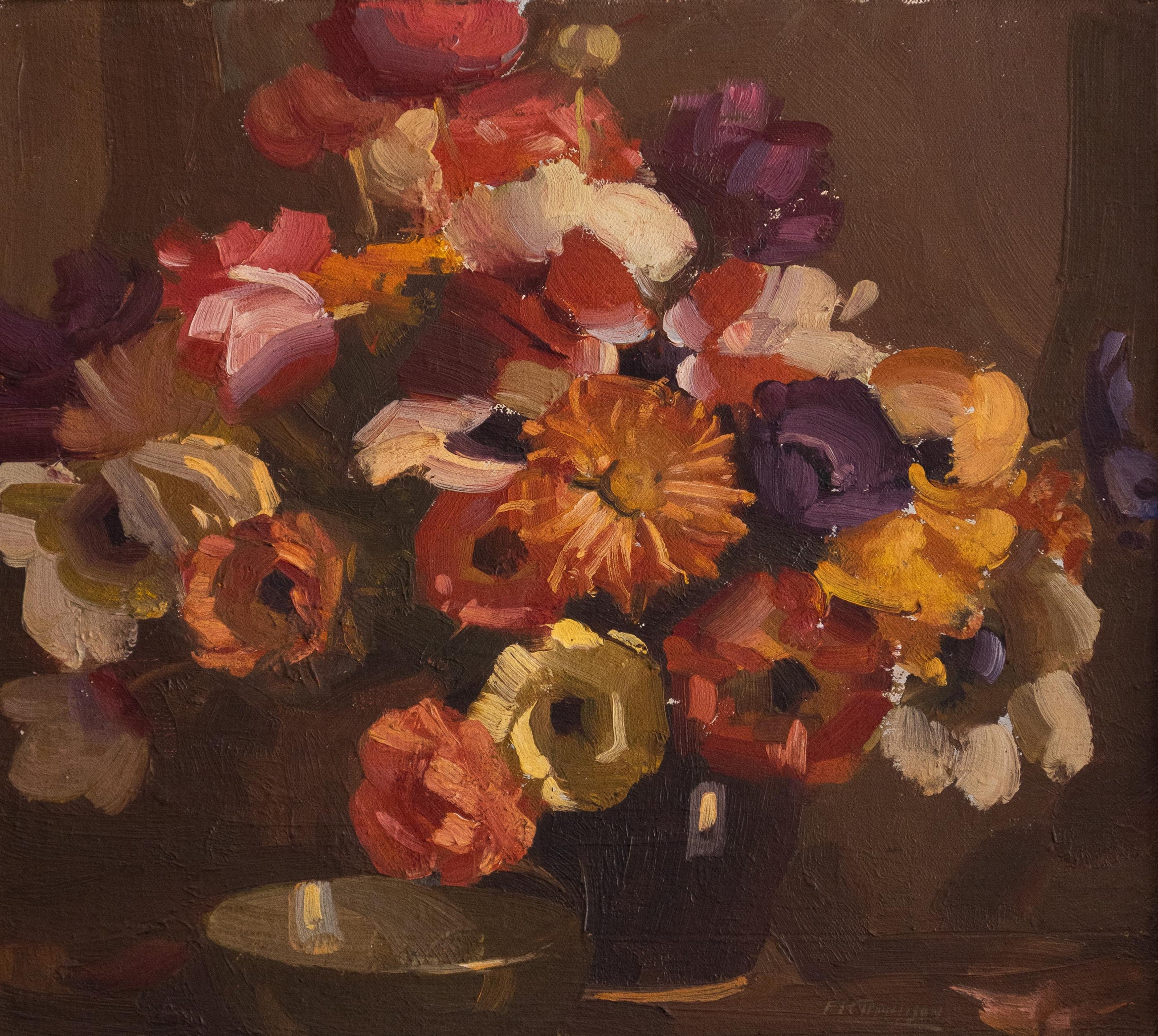
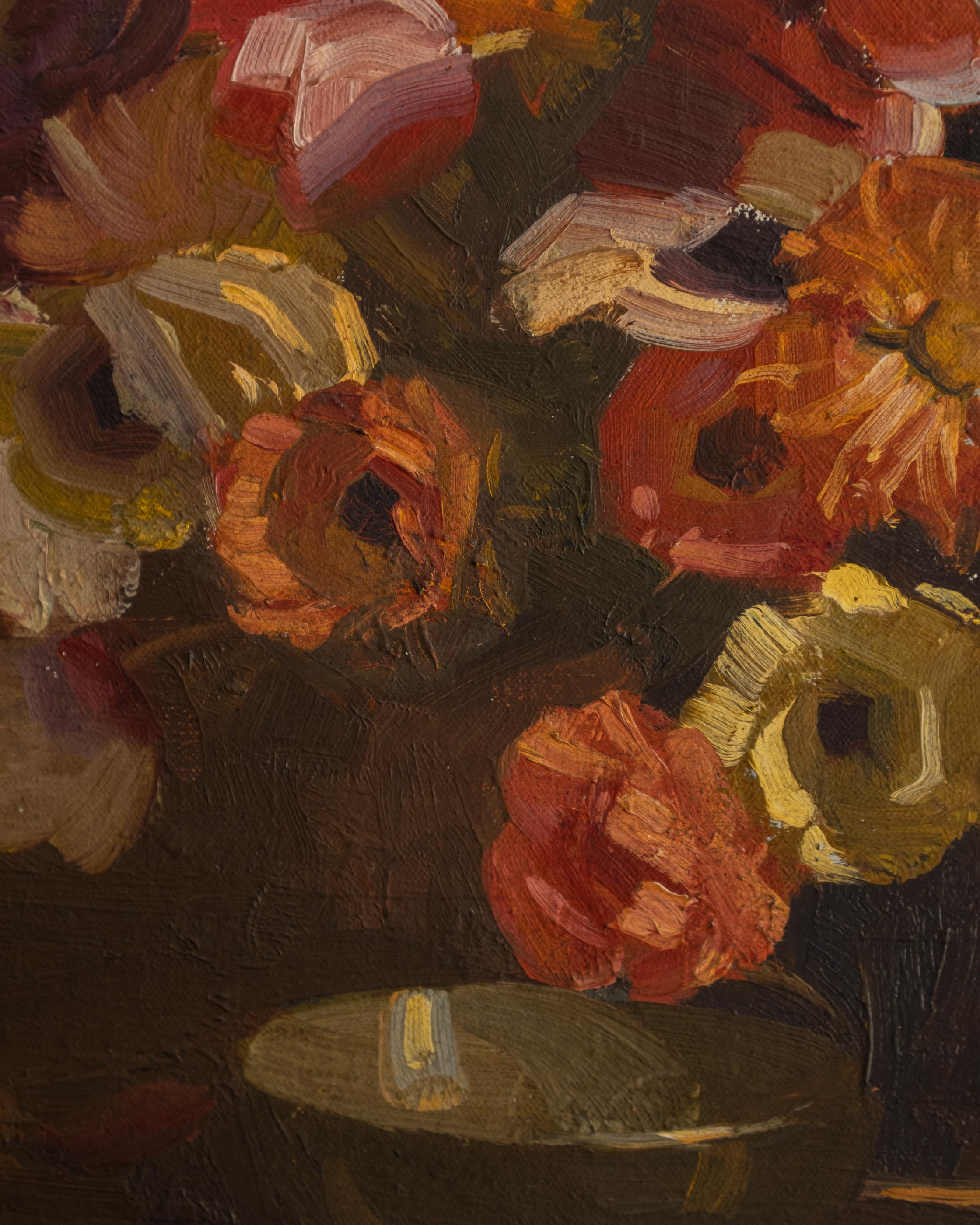
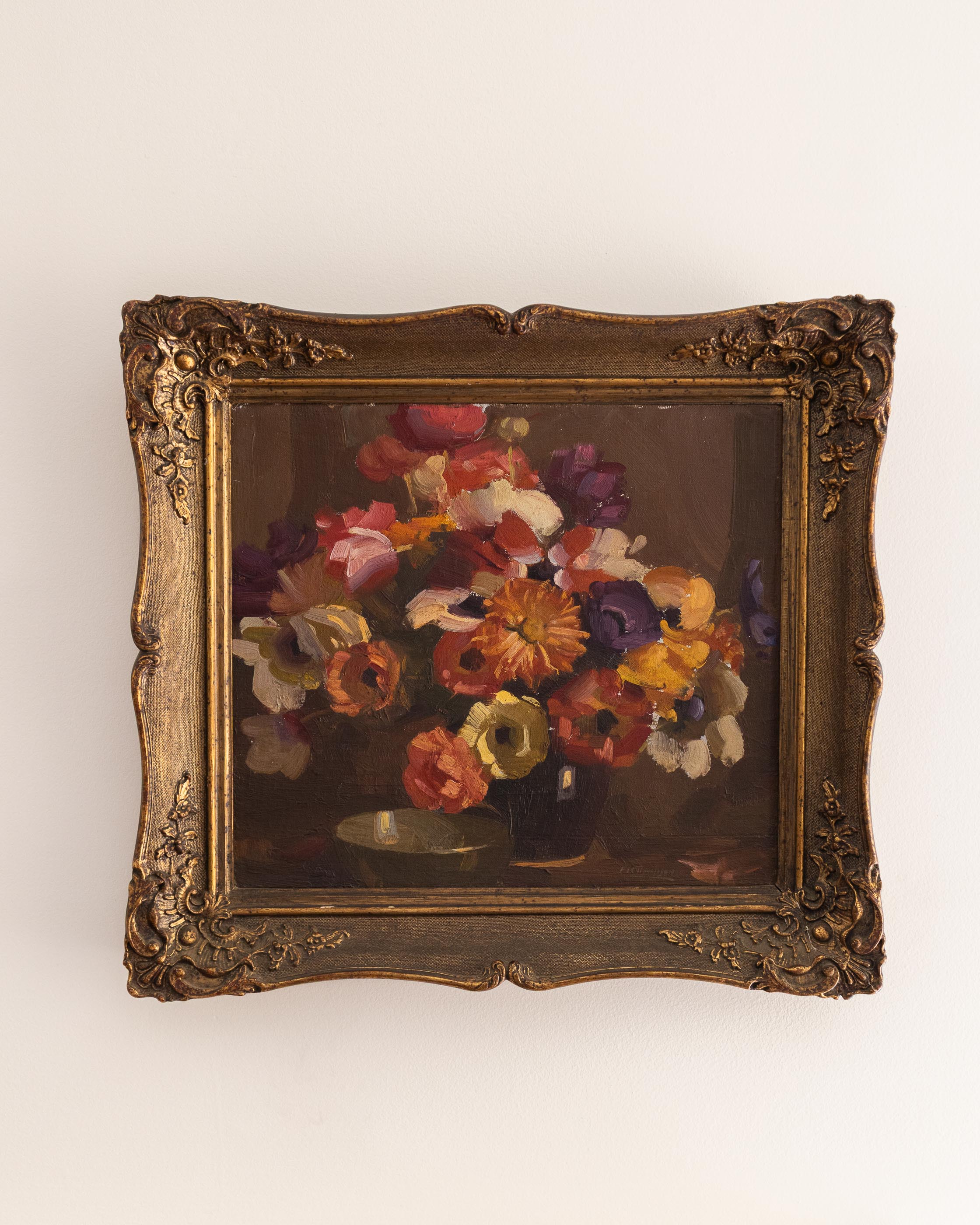
Colour Chaos
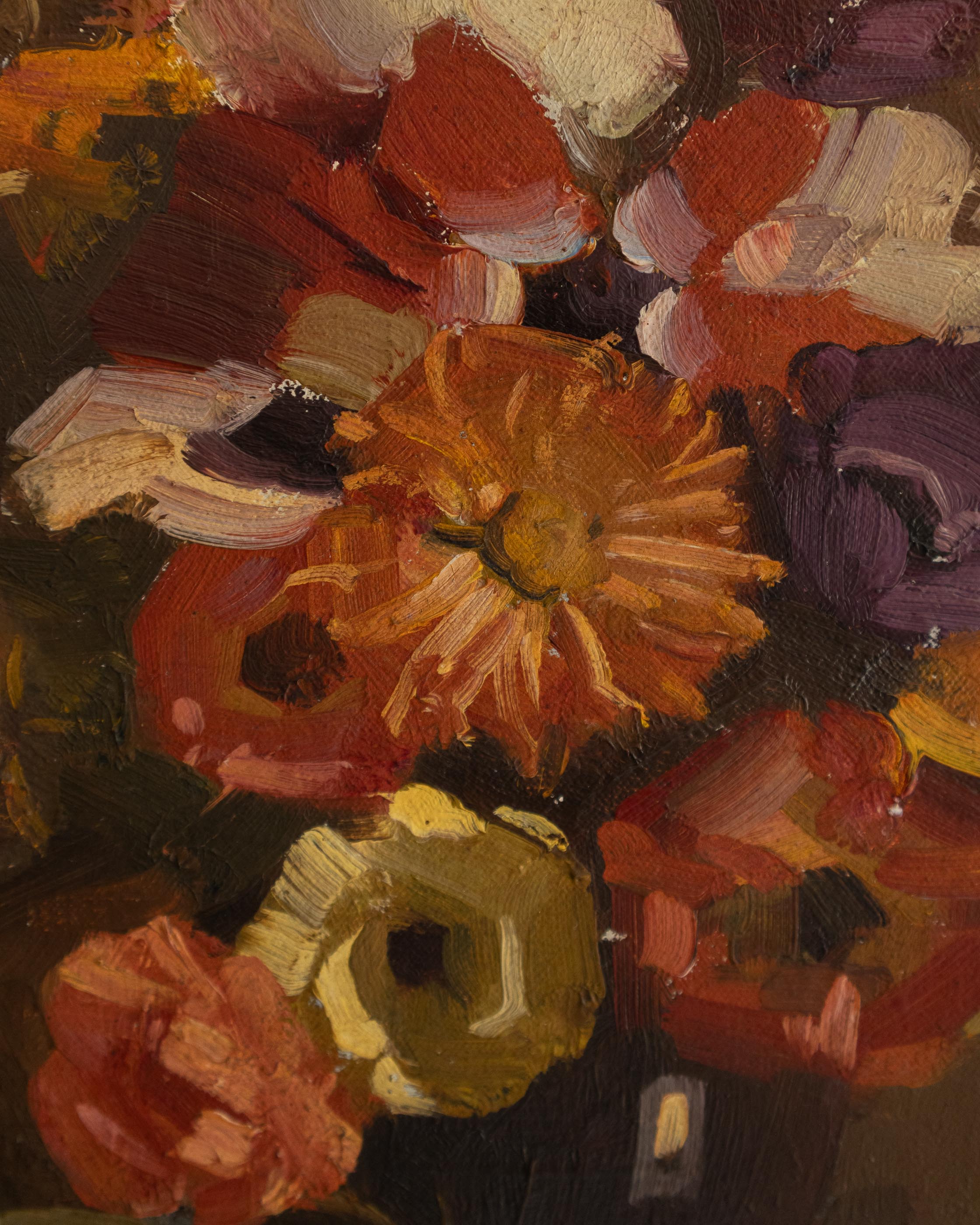
Oil on canvas on board
35 x 40 cm (frame 50 x 54 cm)
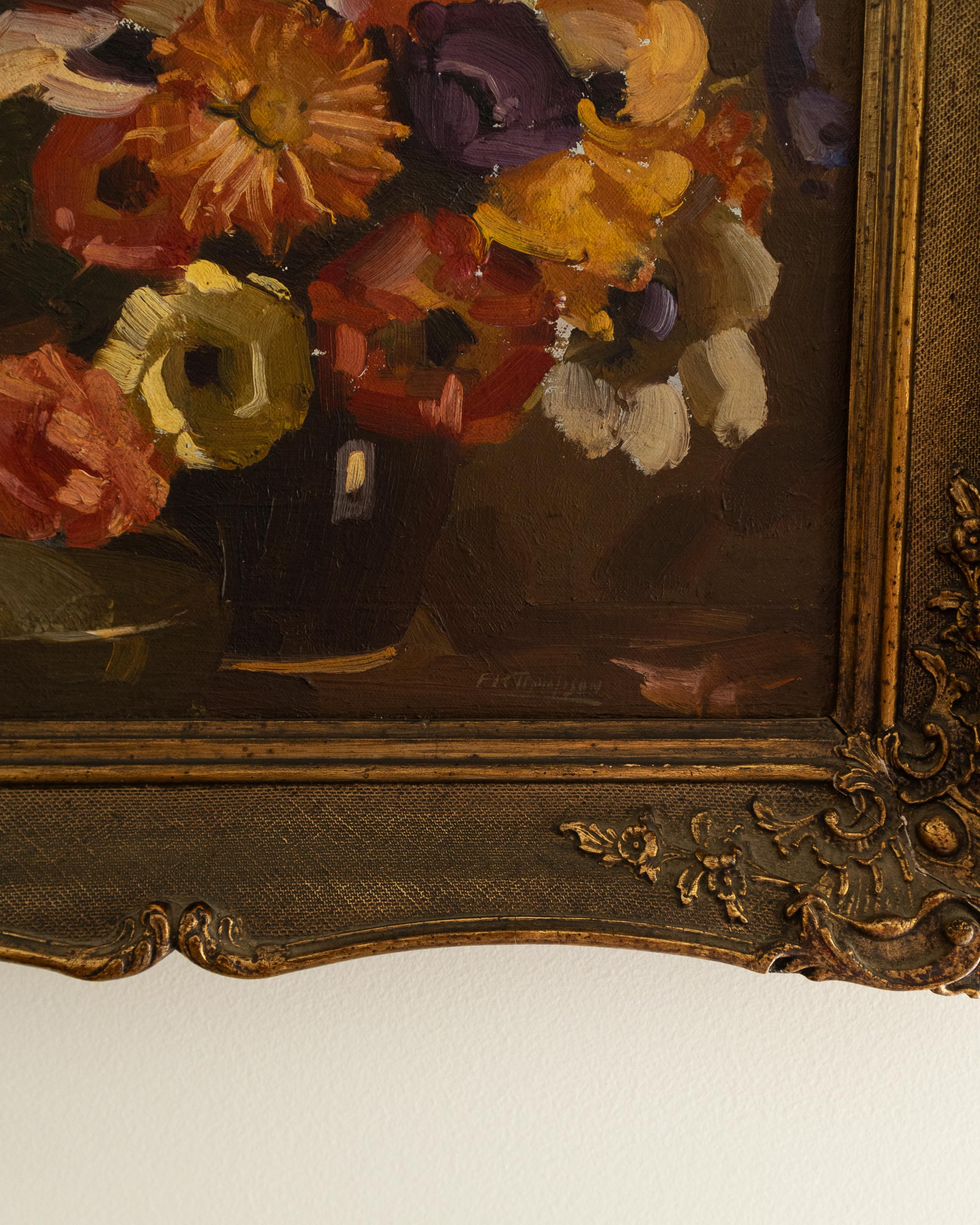
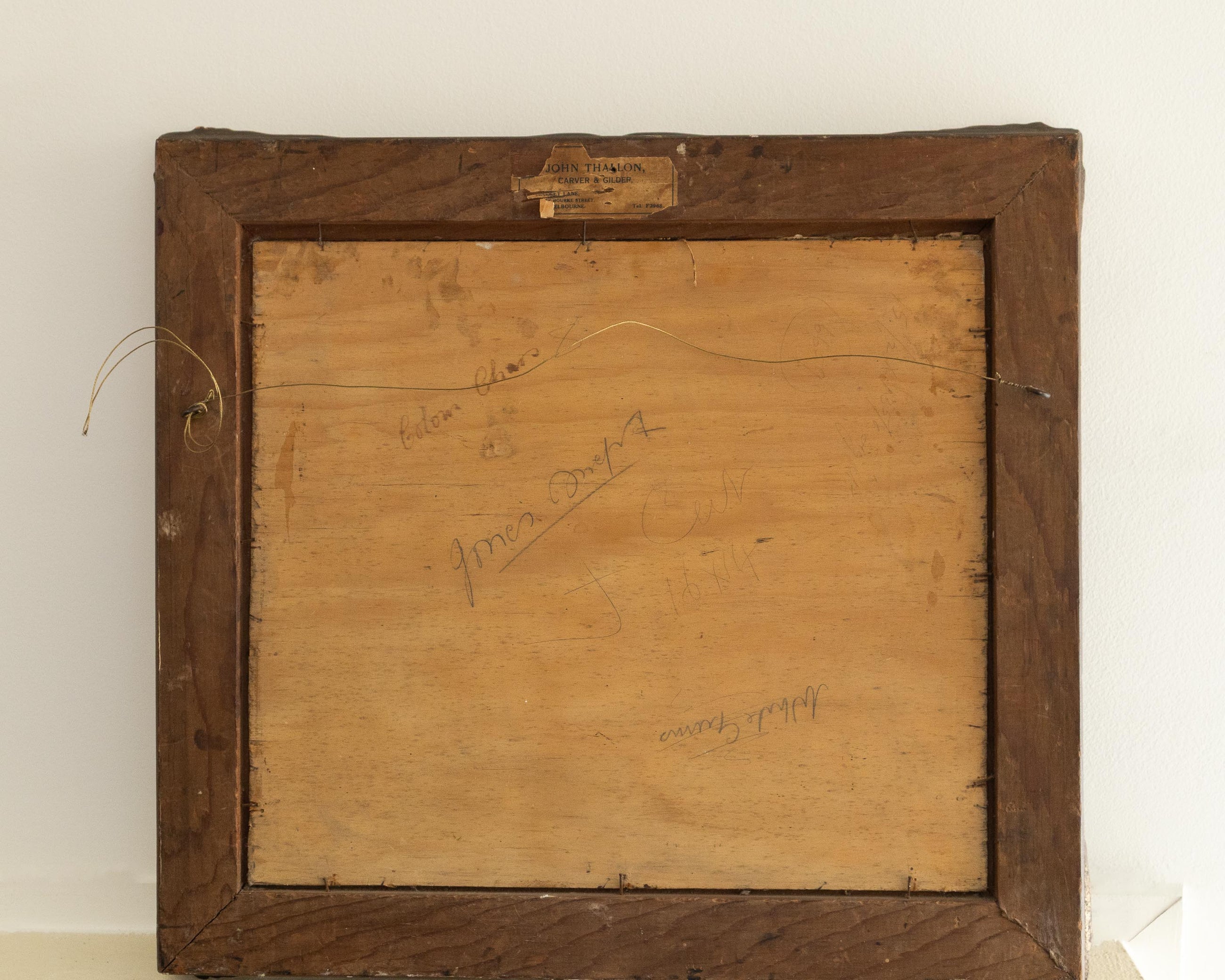
Signed lower right, inscribed verso.
Framed in a John Thallon frame which retains its label.
Exhibited at the New Gallery in May 1928.
~~~~~~~~~~~
THE GEN
The Last of the Bohemians
Francis Roy Thompson was born in Mansfield, Victoria in 1896. He wanted to be an artist from the age of fourteen and took lessons from a nun at a local convent. An inheritance from an uncle enabled him to study painting full-time at the National Gallery Art School from 1920 to 1924 under W.B. McInnes and Bernard Hall; he was awarded the Hugh Ramsay Portrait Prize in 1923. His work was first shown in a joint exhibition with fellow National Gallery Art School graduate, Murray Griffin, in 1925. Many years later he reflected on his studies at the National Gallery Art School and said: “It intrigues me to think that of a hundred or more students who were there only five of us were practising artists.” (Francis Roy Thompson interview with Hazel de Berg, 1962)
During his career, Francis Roy painted portraits, still lifes, landscapes and seascapes. He exhibited as a member of the Victorian Artists Society, the Twenty Melbourne Painters Society, the New Melbourne Art Club, the Melbourne Contemporary Artists, the Royal South Australian Society of Arts and the Contemporary Art Society of South Australia. He was a prolific painter who held at least twenty-five solo exhibitions and contributed to at least sixty group exhibitions. Many of these exhibitions were at the Athenaeum Gallery in Melbourne and John Martin's Art Gallery in Adelaide. His work was also shown in Sydney, Hobart, Perth and London. Basil Burdett observed that: “There is a lyrical quality in his work, quite van Goghian in its intensity, expressed in a vigorous breadth of handling and an opulent use of color and pigment.” (Herald, 23 May 1938, p. 22)
Francis Roy held his first solo exhibition of thirty-eight paintings at the Athenaeum Gallery in March 1927. A reviewer thought that the best paintings in the exhibition were Farmhouse at Mansfield, The Strathbogie Ranges and Ranunculus and that he was “a young artist of promise whose ultimate achievement will depend largely on the use he makes of his naturally keen sense of form and color”. (Age, 15 March 1927, p. 14)
A second solo exhibition of twenty-eight paintings was held at the New Gallery in Melbourne in May 1928. Francis Roy was living in Mansfield and most of the paintings exhibited were landscapes of that district. Colour Chaos was also included in this exhibition amongst a small collection of still life paintings.
In September 1931 Francis Roy returned to Australia after being “away for some time painting abroad”. (Australasian, 17 September 1932, p. 16) He travelled on the Mongolia from London to Melbourne via Fremantle. His recollection of his time abroad was that: “I discovered there was such a thing as contemporary art which was a great shock to me.” (Francis Roy Thompson interview with Hazel de Berg, 1962) Some of the works that he painted on his overseas trip were: Place de la Madeleine Paris; Fishing Boats at Cassis; Island of Capri; Bridge, Assisi; Wet Day in Paris and Boats, South of France.
Francis Roy was employed as an art master at Scotch College for ten years. His retirement from Scotch College in 1946 enabled him to concentrate on painting and to occasionally travel. In 1947 he spent a few months painting in Tasmania. He recalled visiting the village of Stanley where the “fishermen frequently interrupted their work to hoist a sail or move a boat to suit whatever painting he was working on”. (Australian Women's Weekly, 17 April 1948, p. 24) In 1949 Francis Roy accompanied the president of the Society of Arts, George Whinnen, on a painting trip to the Flinders Ranges. H.E. Fuller's opinion of the Flinders Ranges paintings was that: “His work on the whole is brilliant and dazzling and his color in most of his pictures, while true to nature, is almost unbelievable—like a fantasy or dream.” (Advertiser, 28 February 1950, p. 7) The Spur, Flinders Ranges was a finalist in the 1950 Wynne Prize. A number of large landscapes were painted on a visit to Alice Springs in 1951. Ivor Francis felt that: “These rich, sumptuous paintings are among the best this artist has produced. Each is a major work, fully worked out and developed, and outstanding in design, color, and vitality.” (News, 4 March 1952, p. 10)
In early 1950 Francis Roy settled permanently in South Australia where he became a central figure of Adelaide’s post-war modernism. He painted in a loft-studio above the garage at Dr Nevill Bickford's home in Kent Town. This arrangement continued when the home was sold to the Moulds family in 1953. Mrs Moulds operated an antique business from the home called Norwood Galleries. Some of Francis Roy's paintings were displayed in one of the rooms and available for sale. He was described at this time as “one of the last of Australia's Bohemian painters” who “paints in an incredibly untidy, uncomfortable attic, allows his beautiful white hair to grow nearly to his shoulders, never worries much about where his next meal is coming from”. (Pix, 19 June 1954, p. 26)
Francis Roy developed a reputation as a painter of flowers. H.E. Fuller considered that: “Flower studies perhaps stand out as his best work.” (Advertiser, 2 August 1951, p. 10) He won the Crouch Memorial Art Prize in 1943 for an oil painting of lilies and the Jubilee State art prize in 1951 for Gladioli and Magnolia. A solo exhibition of thirty of his flower pieces and still lifes was held at John Martin's Art Gallery in July 1950. This exhibition “drew the biggest crowd seen at an opening at John Martin's Art Gallery for some time”. (Advertiser, 22 July 1950, p. 7) Ivor Francis regarded the works in this exhibition as “sheer poetry in paint”. (News, 18 July 1950, p. 17) Among the flower paintings exhibited were Monsteriosa Lily, Hibiscus, Pink Proteas, A Bowl of Chrysanthemums, Magnolia, Hippeastrum, Roses and Zinnias. A seasonal shortage of flowers made it difficult for Francis Roy to find subjects for these paintings and he relied on the generosity of Adelaide gardeners: “When I see some in a garden that I can't buy, I ask...People always tell me to take as many as I like.” (Mail, 15 July 1950, p. 40)
In February 1953, Francis Roy was working on thirty paintings for an overseas exhibition. These paintings were shipped to London and exhibited in November 1953. His work was also included in an exhibition of the Contemporary Art Society of South Australia that was held in London in August 1954. He was awarded the Cornell Prize by the Contemporary Art Society of South Australia in 1956.
By 1961 Francis Roy was painting in an abstract style in the studio. He explained this change in an interview with Hazel de Berg: “People ask me why I turned to abstract. In a realistic way I have done work as well as I can do it. To me the important things in art are design, colour and vitality, everything else is superfluous...If you work outside it gives you the wrong impression of things and so all the work is done in the studio. I needed to do a lot of sketches outside but now I just see it in my mind.” (Francis Roy Thompson interview with Hazel de Berg, 1962)
Francis Roy died in 1966 at the Mount Barker Hospital in the Adelaide Hills. Writing of Francis Roy's funeral, on a wet grey day in Adelaide, the painter Ruth Tuck recalls the actor Wladyslaw Dutkiewicz stepping forward and, in a moment when miraculously the sun was shining, he paid tribute, “Roy! We have come to say goodbye; we’re here today because we are your friends and we love you. We’ve been to your studio garden Roy and gathered some of your flowers for you. They’re flowers you loved to paint so much. The colour of these flowers you’ve left in your paintings Roy, we’ve bought for you today the soursobs, the salvation jane, the pansies and the lilies and the roses.” (Francis Roy Thompson, Adam Dutkiewicz, Royal South Australian Society of Arts 1993, p. 16)
There were retrospective exhibitions of his work at the Wangaratta Warby Gallery in 1975, the Royal South Australian Society of Arts Gallery in 1993 and Carrick Hill in 2014.
He is represented in the National Gallery of Victoria, Art Gallery of South Australia, Tasmanian Museum and Art Gallery, Art Gallery of Ballarat, Bendigo Art Gallery, Hamilton Gallery, Benalla Art Gallery and Broken Hill City Art Gallery.
You can listen to Francis Roy Thompson discuss his art with Hazel de Berg here.
© 2026 Georgegen. All rights reserved.
~~~~~~~~~~~
Would you like more information?
Make an enquiry via email here.
All delivery costs are calculated by the size and weight of the items in your order and confirmed at checkout. All items are sent with a fully insured service. See our full shipping policy here.
~~~~~~~~~~~
Australian Delivery
Charges start at $19, with delivery taking 3 to 5 business days.
~~~~~~~~~~~
International Delivery
Is available on most items, with charges automatically calculated in the cart, except for fine art where a custom quote can be requested.
~~~~~~~~~~~
Returns
Items may be returned for a full refund. More information and full details can be found here.
