



George Duncan (1904–1974)
George Duncan (1904–1974)
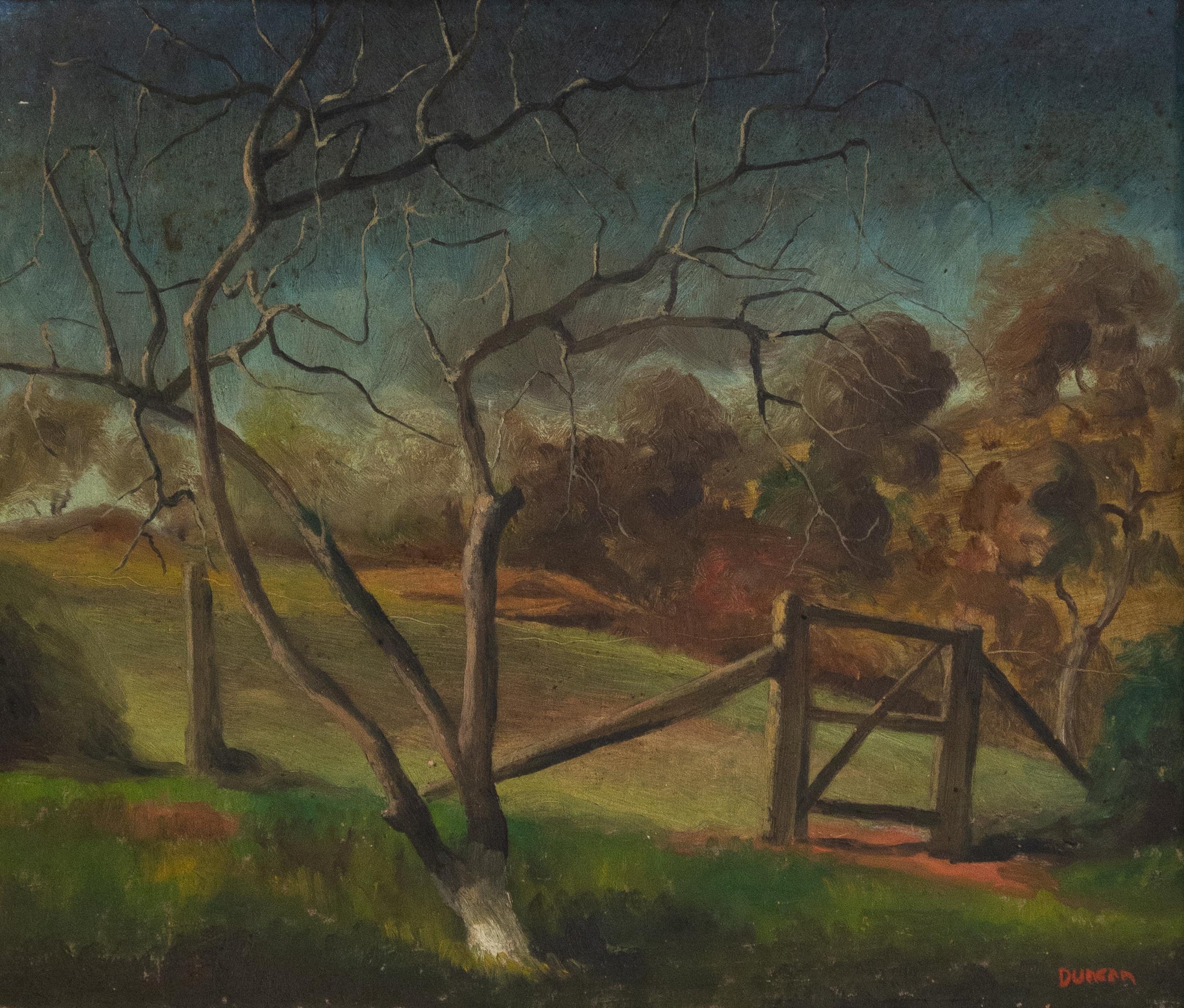
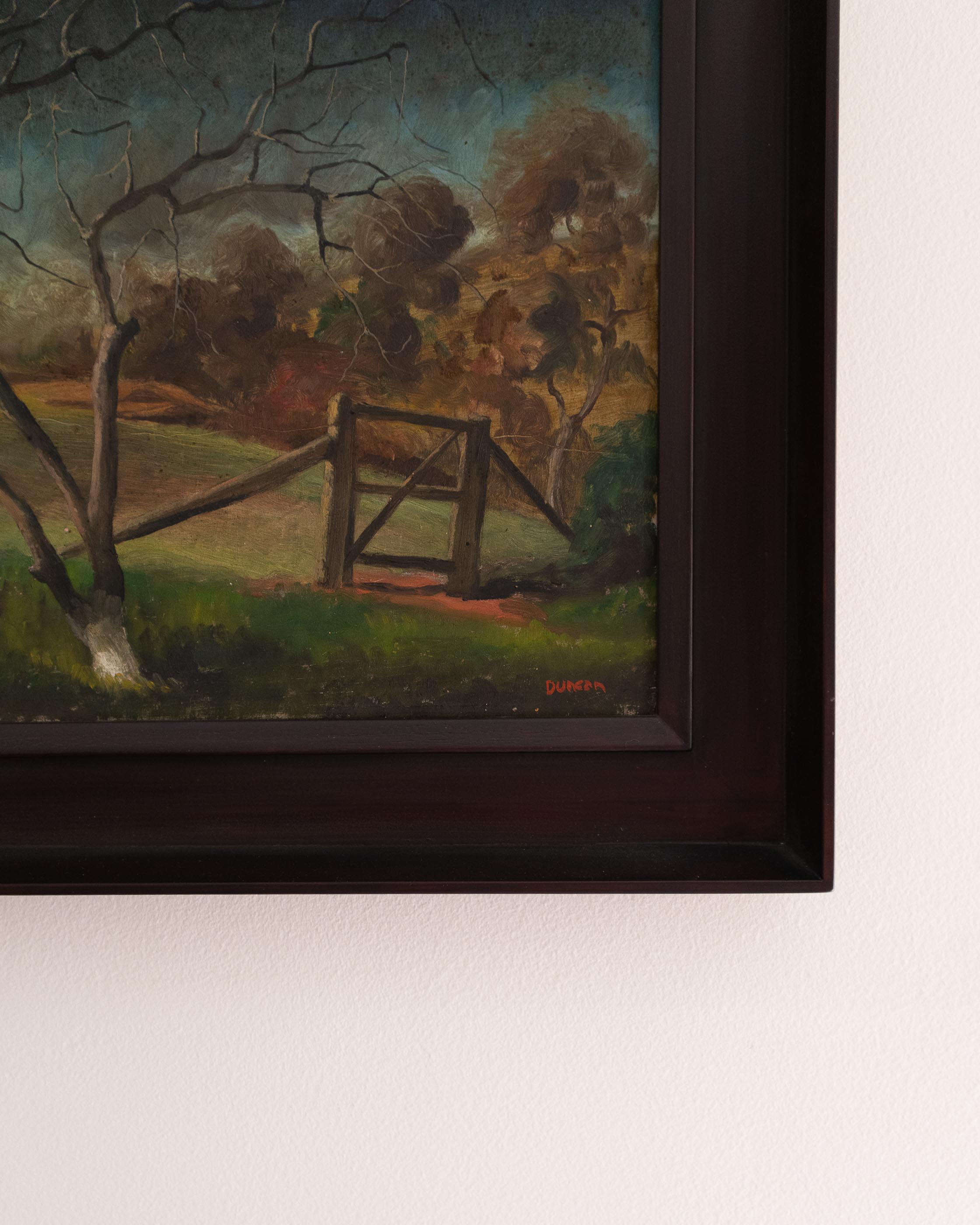
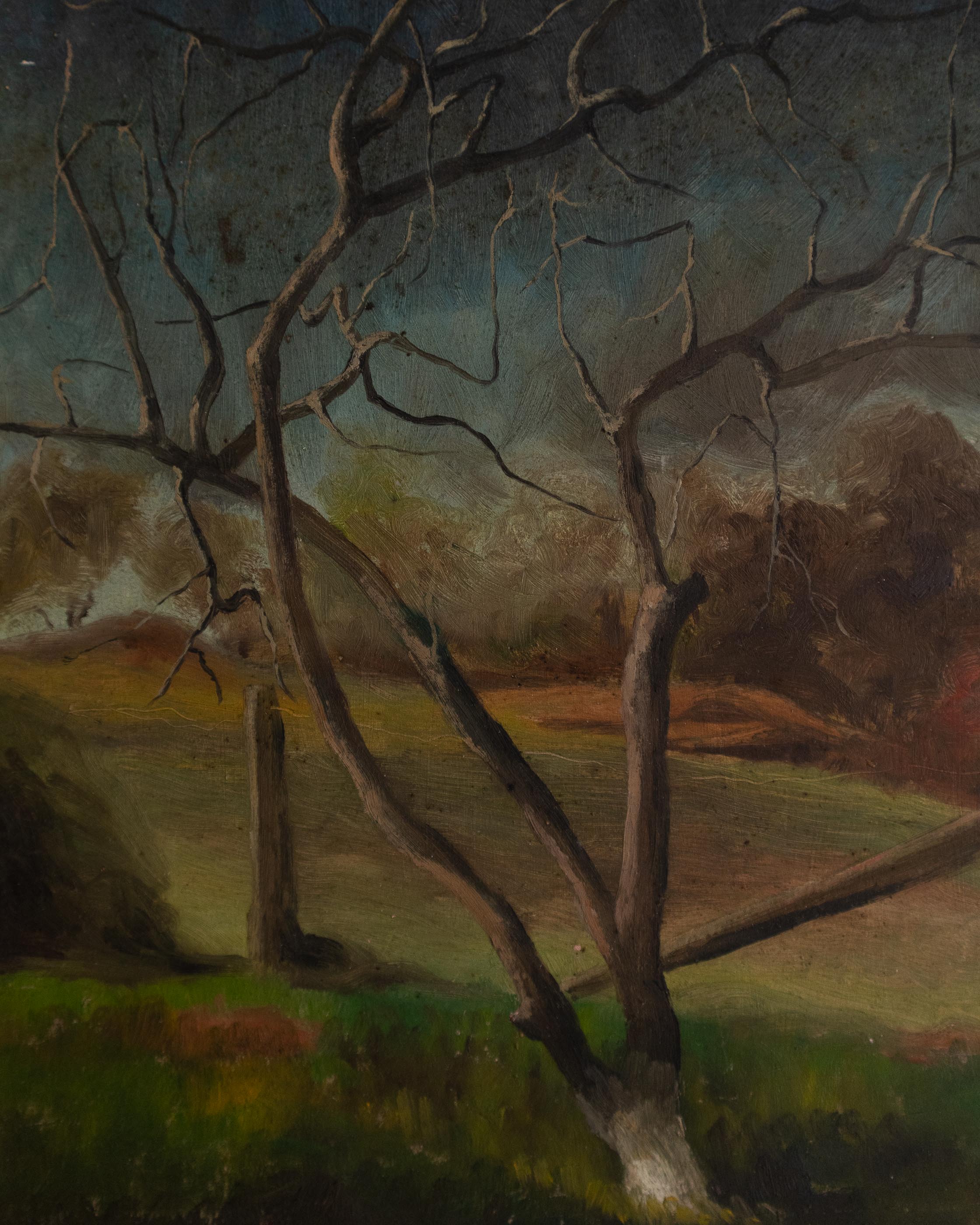
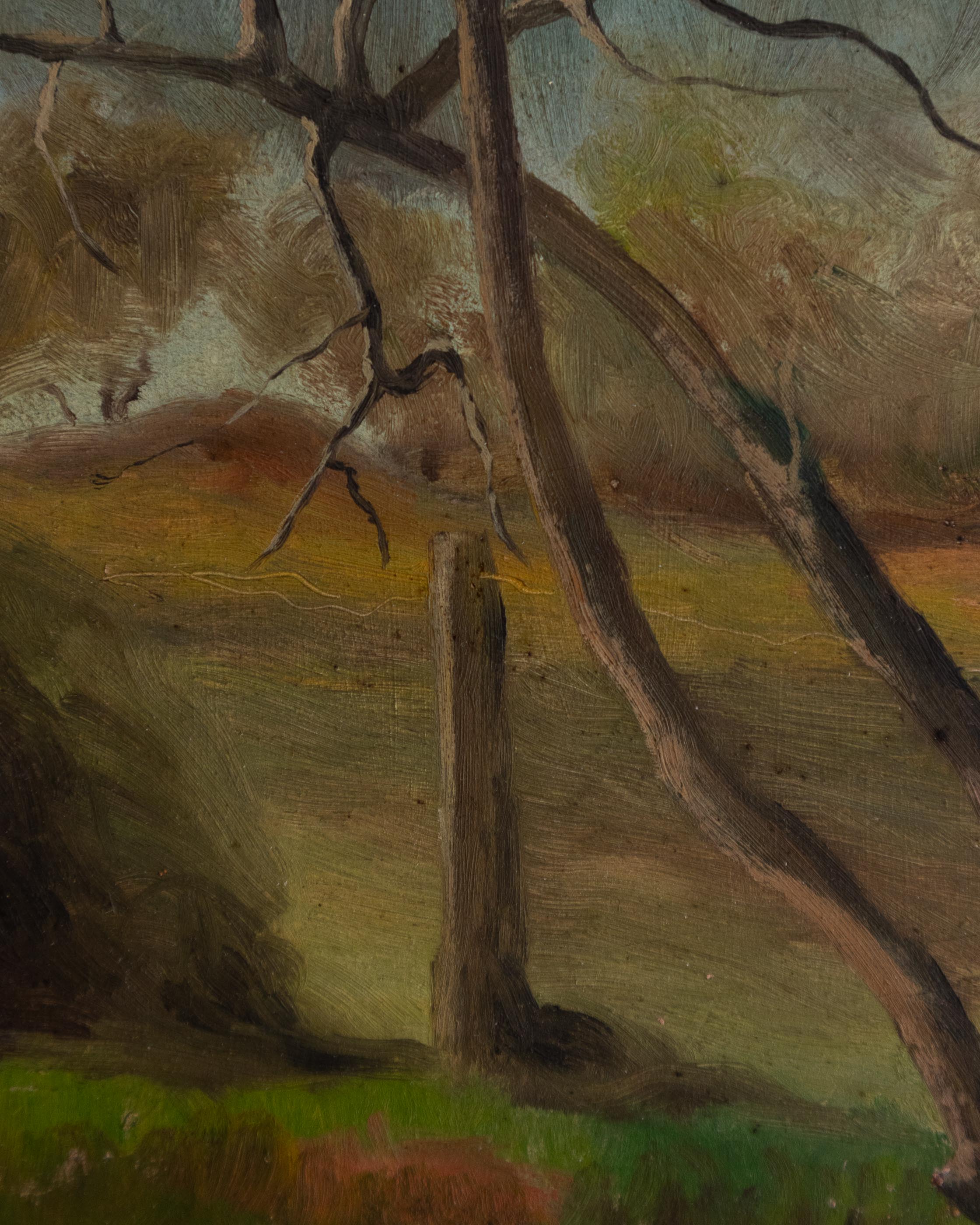
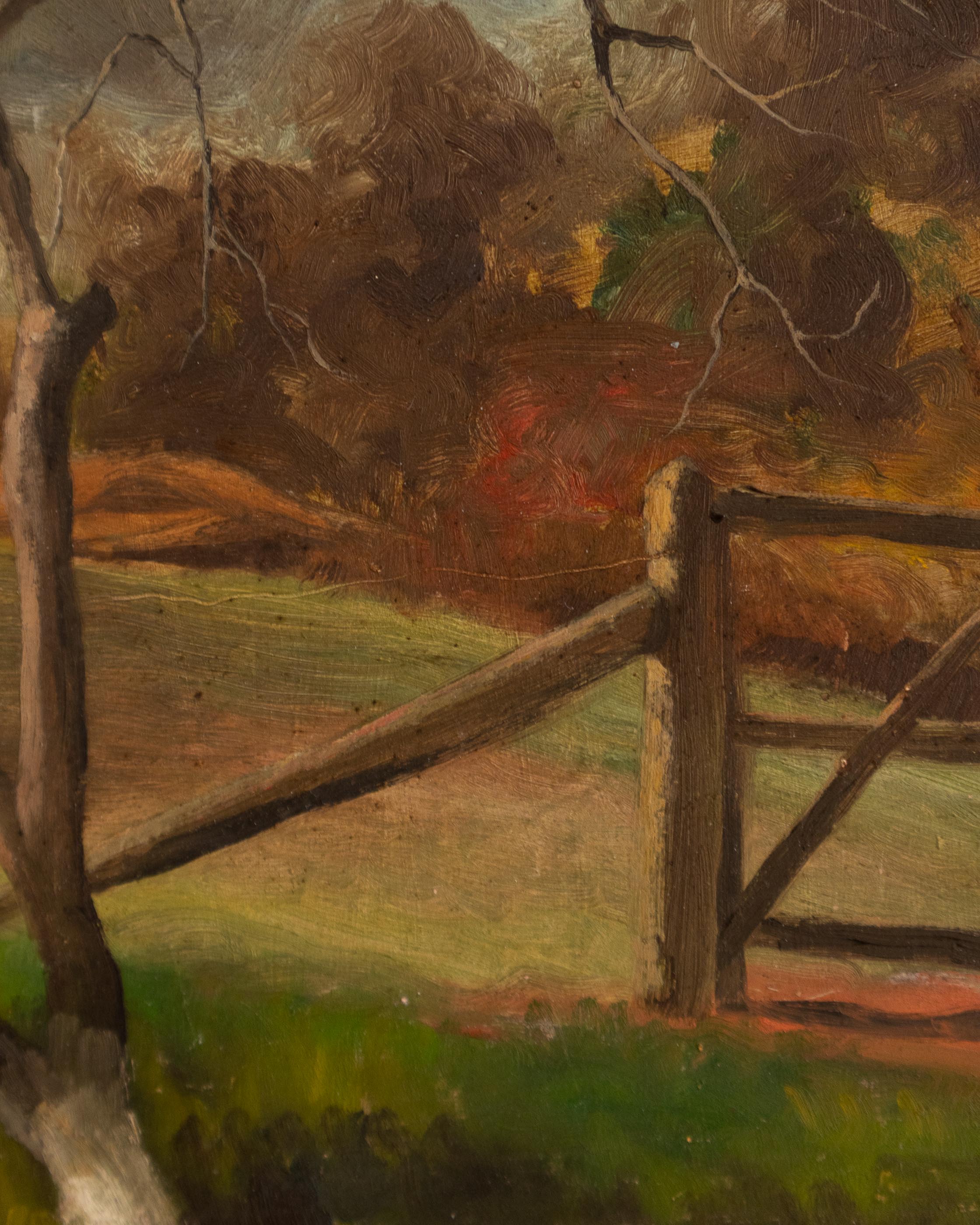
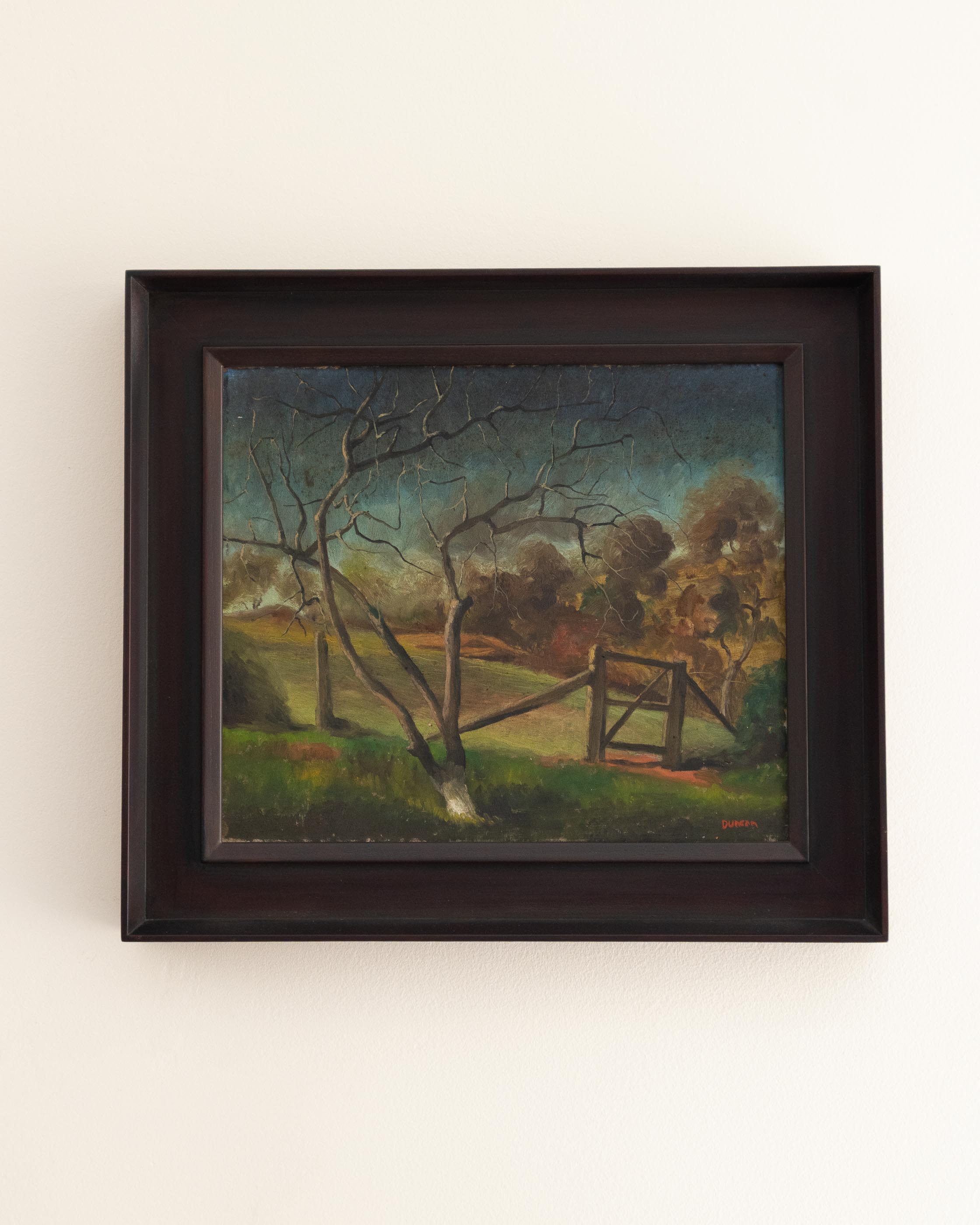
Orchard Gate
Oil on ply
30 x 35 cm (frame 41.5 x 47 cm)
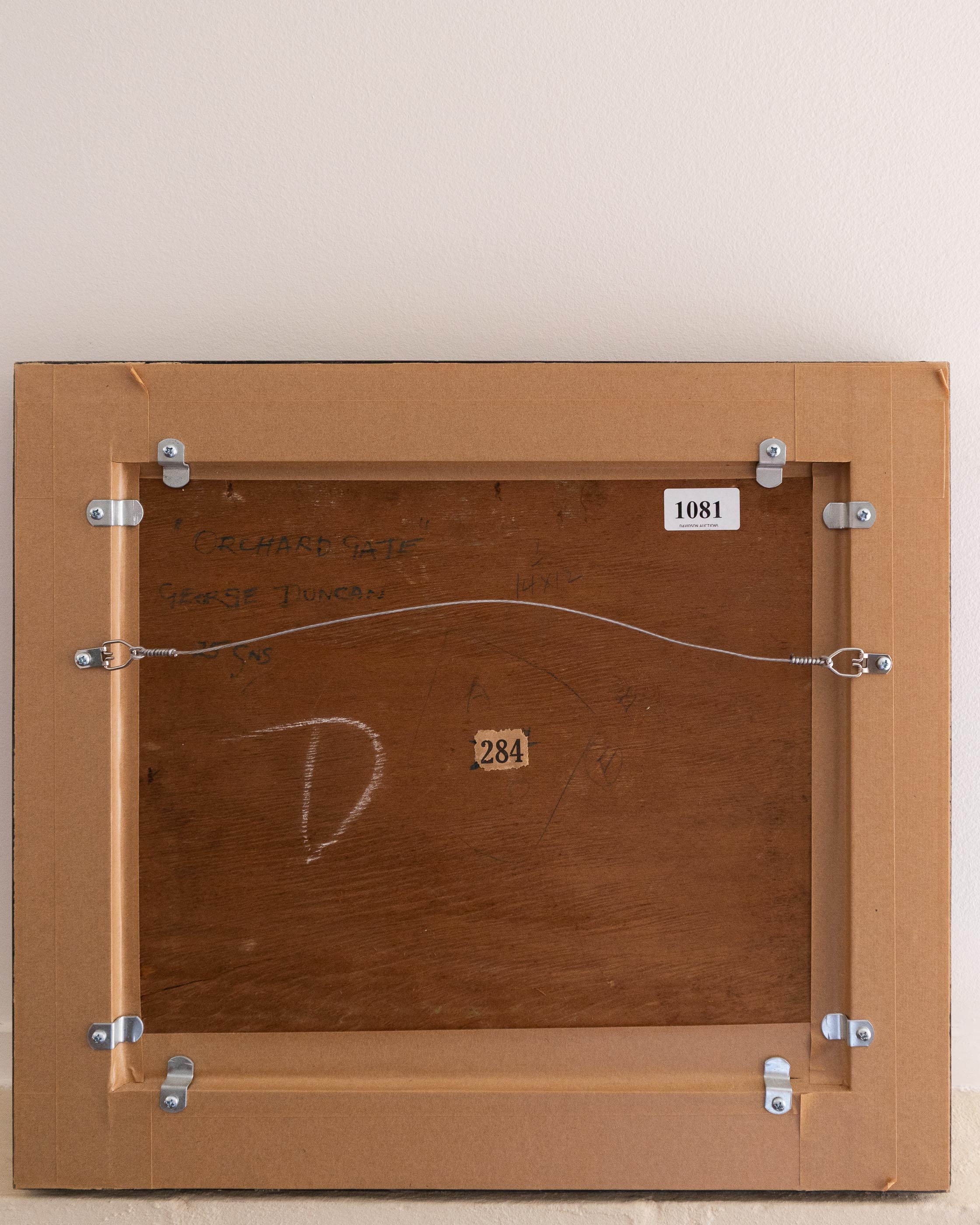
Signed lower right ‘Duncan’, inscribed verso.
~~~~~~~~~~~
THE GEN
Let George Do It
George Bernard Duncan was born on 7 January 1904 in Auckland, New Zealand, to Australian parents. George was a notable figure in Australian artistic circles, not only for his talent as an artist, but also for his many years of service in Australian art organisations and galleries.
A physical giant of a man at 6 feet 7 inches in height and weighing 20 stone, George was, according to friend and colleague, Margaret Coen, “the guardian angel of the Royal Art Society. Big, blonde, blue-eyed obliging George – if anything went amiss in the place, we said, ‘Let George do it.’ ‘Let George do it’ was the class catchword.” (Autobiography of My Mother, Meg Stewart, Vintage Australia, 2007, p. 148)
And do it George did. Even from his earliest years, George found a way to do it. George showed artistic talents and inclinations from a young age, but neither of his parents had any interest in art and gave little encouragement to his artistic desires. Due to the family’s modest financial circumstances, at the age of fourteen, George needed to begin working, doing so at an oil company which required him to complete a diploma in mathematics and science. However, his artistic passion remained, and sometime around his late teens he enrolled in the Sydney art school of Antonio Dattilo-Rubbo, at the Royal Art Society. George’s natural artistic talents and endeavour saw him awarded the Royal Art Society’s student exhibition prize in 1926.
Dattilo-Rubbo’s art school would completely shape George’s professional and personal life. It was there that he would meet the love of his life, later to become his wife, the now notable Australian artist Alison Rehfisch. Indeed, it was Dattilo-Rubbo who introduced them to each other, taking George into the studio one day and saying “George, this is Gorgeous (Alison Rehfisch) I want you to look after her.” George would later recall: “We seemed to belong to each other on that first day.” (The Age, Good Weekend, 20 April 2002, p. 26)
George and Alison would remain inseparable from this day on. In April 1933, they held the first of what would become many joint exhibitions, at Macquarie Galleries in Sydney, receiving favourable reviews from The Sydney Morning Herald’s art critic. (Sydney Morning Herald, 21 April 1933, p. 7) Soon after this exhibition, George would embark for Europe, spending a total of six years abroad. He would travel and paint extensively, painting in the United Kingdom, France, Germany and Spain. It was during these years abroad that George would come of age as a painter, finding his own artistic maturity and style. (George Duncan interviewed by Hazel de Berg, Hazel de Berg Collection, DeB 116, National Library of Australia, Canberra)
It was in London that George would gain his most significant public recognition. His work was included in the Six Colonial Artists exhibition at the Cooling Galleries, New Bond Street, in 1934. George would also exhibit with the Royal Institute of Oil Painters, Royal West of England Academy, British Empire Society of Arts, Leicester Galleries and New Burlington Galleries. Two of his paintings, Puente Nova at Ronda and Pastoral with Ruined Priory, were displayed at the Royal Academy, London in 1936 and this received press coverage in Australia at the time. (Australian Watercolour Institute, Biography of George Duncan)
In 1939, the outbreak of the Second World War would see George return to Australia. He would work as a camouflage artist during the war for the Allied Works Council. The work took him to remote areas of regional New South Wales. It was during this time that George would develop a heightened appreciation for the beauty of the Australian landscape, finding an inspirational muse in rural, country landscapes, which would become a major part of his artistic oeuvre.
On 15 June 1947, George and Alison would suffer a great personal and professional tragedy. Their art studio was engulfed and ravaged by a disastrous fire which destroyed a large quantity of their work. The enormous fire had started in an upper floor of the Postmaster General’s transmission laboratory off Underwood Street (between George and Pitt Streets) before spreading to adjacent buildings, with the fire so spectacular it reportedly attracted 20,000 people to watch it. (Sydney Morning Herald, 16 June 1947, p. 1)
The financial stress resulting from the fire, and the fact that major critical acclaim eluded him, meant that George often had to work other jobs. For a period after the fire, George worked in a nursery. In August 1957 George was appointed as Director of David Jones Art Gallery in Sydney, a position he would retain for a decade. George would also serve a six-year term as president of the Australian Watercolour Institute between 1958 and 1964. Sadly, as he openly confided to Hazel de Berg, he came to feel that those years he spent in administration were wasted with regards to his own artistic career. (Alison Rehfisch, Rachel Power, The Beagle Press, 2002, p. 105)
Despite the tragedies and struggles, his passion for painting never waned. George and Alison were both enthralled by the New South Wales landscape “and emphasised the gradations of colour banded across the sky in turbulent weather”. (Alison Rehfisch, Rachel Power, The Beagle Press, 2002, p. 105) In a commentary on George’s July 1950 Macquarie Galleries exhibition, James Gleeson of The Sun wrote: “He loves the spectacle of thunderous and dramatic autumns, the richly sombre landscapes, gleaming in a twilight of storm-clouds and the sullen fierce light striking from behind a range of distant hills.” (Alison Rehfisch, Rachel Power, The Beagle Press, 2002, p. 105)
George passed away to cancer on 8 May 1974. Legendary artist and close friend, Lloyd Rees, delivered the eulogy at his funeral. Disconsolate with grief and suffering from deteriorating eyesight, his widow, Alison, took her own life on 12 March 1975, survived by her daughter. “While the long, loyal alliance of George Duncan and Alison Rehfisch is among the great romances of Australian art history, their oeuvre is integral to that narrative.” (Australian Watercolour Institute, Biography of George Duncan)
A joint retrospective exhibition of their work was held in memoriam at the Macquarie Galleries in Sydney and Canberra in 1976. Writing about the posthumous exhibition in the Canberra Times, abstract artist, Geoffrey De Groen, in an article titled ‘Sublime Landscapes’ described the exhibition as “sublime, poignant and as exhilarating as a dream”. De Groen finishes his piece “Duncan died in 1974. Alison Rehfisch could not bear his absence and suicided a few months later. But in the scattered trees and bushes, the crouching shapes bent by the wind, one can see the spirit of the two.” (Canberra Times, 8 April 1976, p. 17)
You can hear George Duncan discuss his approach to painting landscapes with Hazel de Berg here.
© 2026 Georgegen. All rights reserved.
~~~~~~~~~~~
Would you like more information?
Make an enquiry via email here.
All delivery costs are calculated by the size and weight of the items in your order and confirmed at checkout. All items are sent with a fully insured service. See our full shipping policy here.
~~~~~~~~~~~
Australian Delivery
Charges start at $19, with delivery taking 3 to 5 business days.
~~~~~~~~~~~
International Delivery
Is available on most items, with charges automatically calculated in the cart, except for fine art where a custom quote can be requested.
~~~~~~~~~~~
Returns
Items may be returned for a full refund. More information and full details can be found here.
