Victorian
Circa 1880–1890 | United States
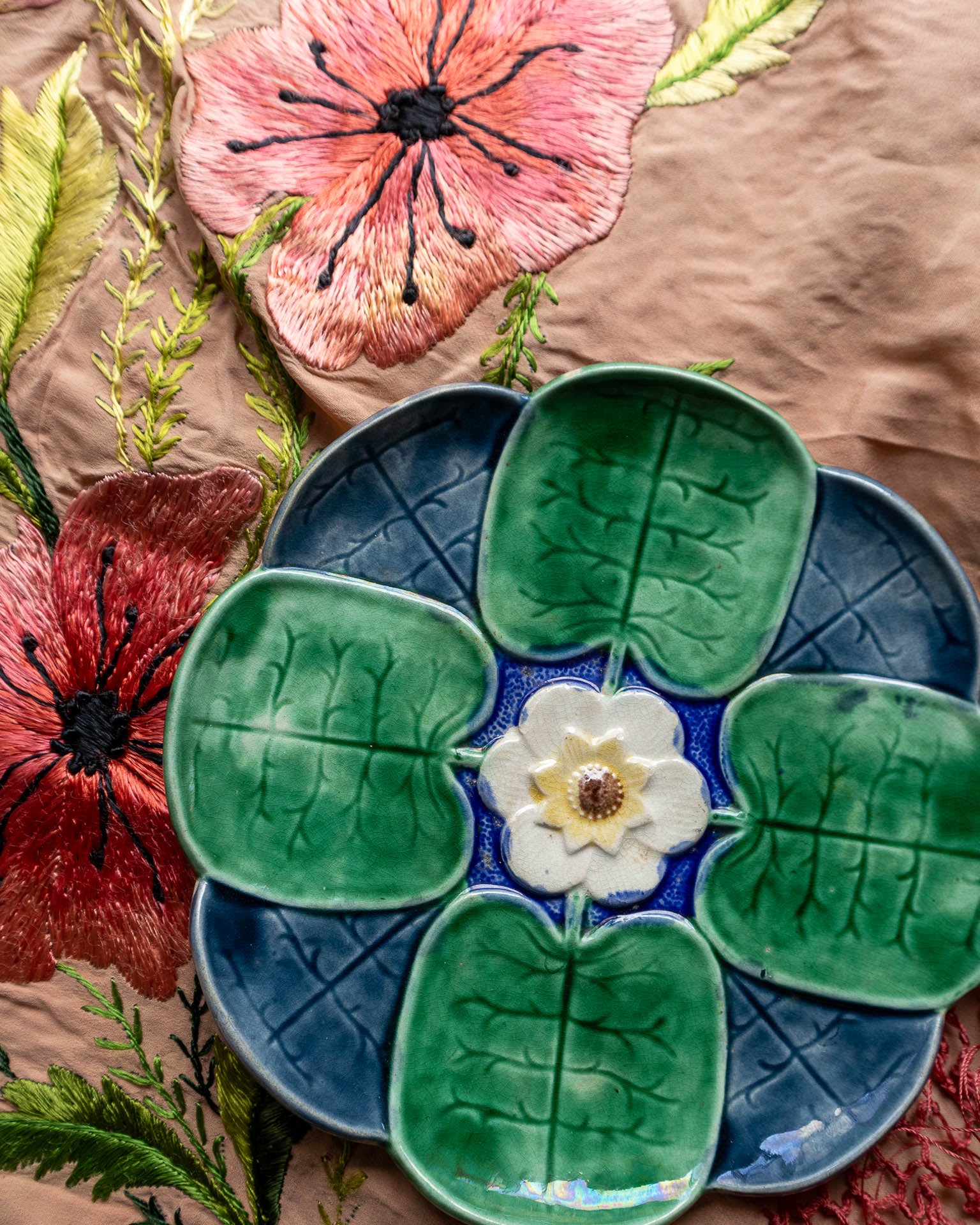
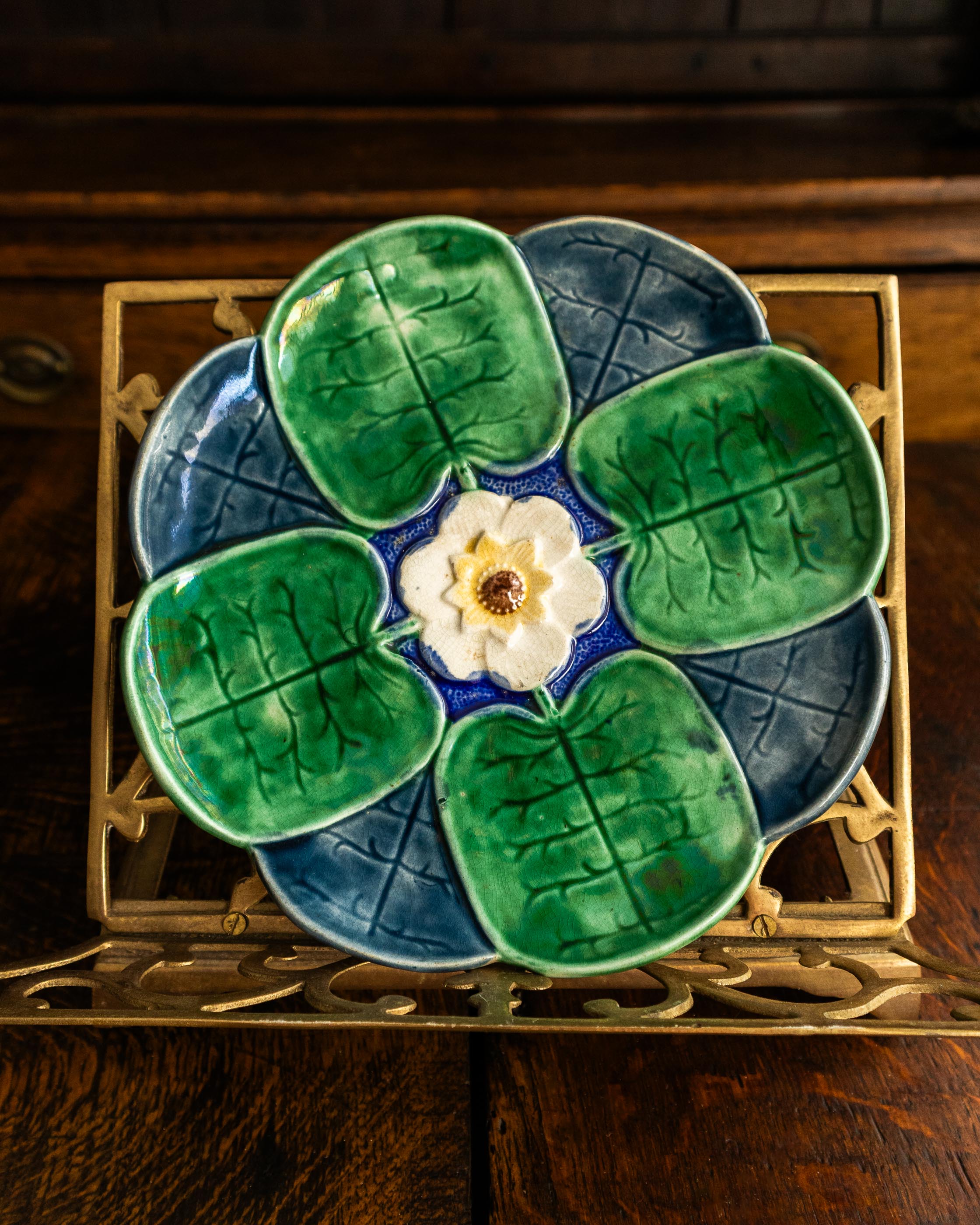
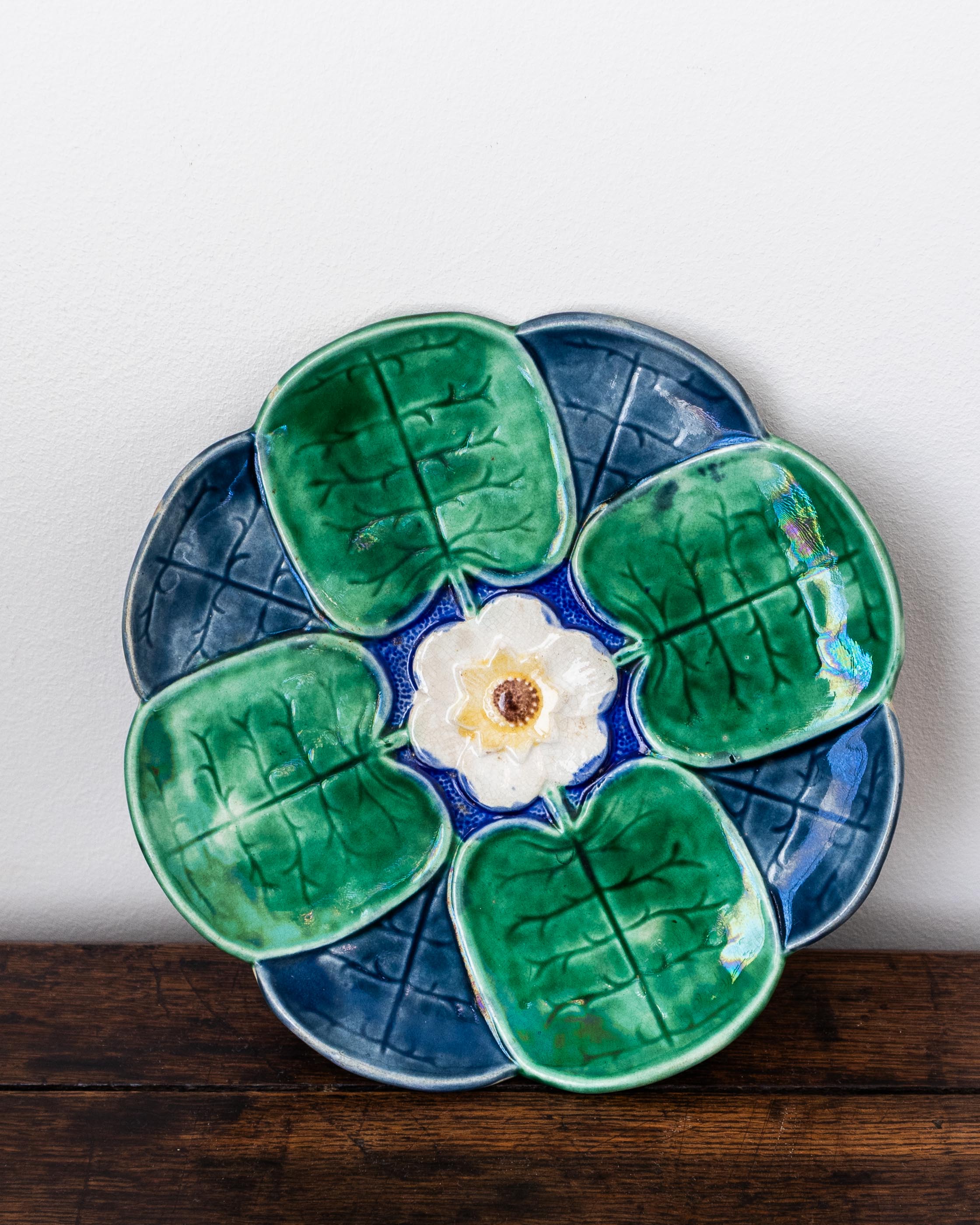
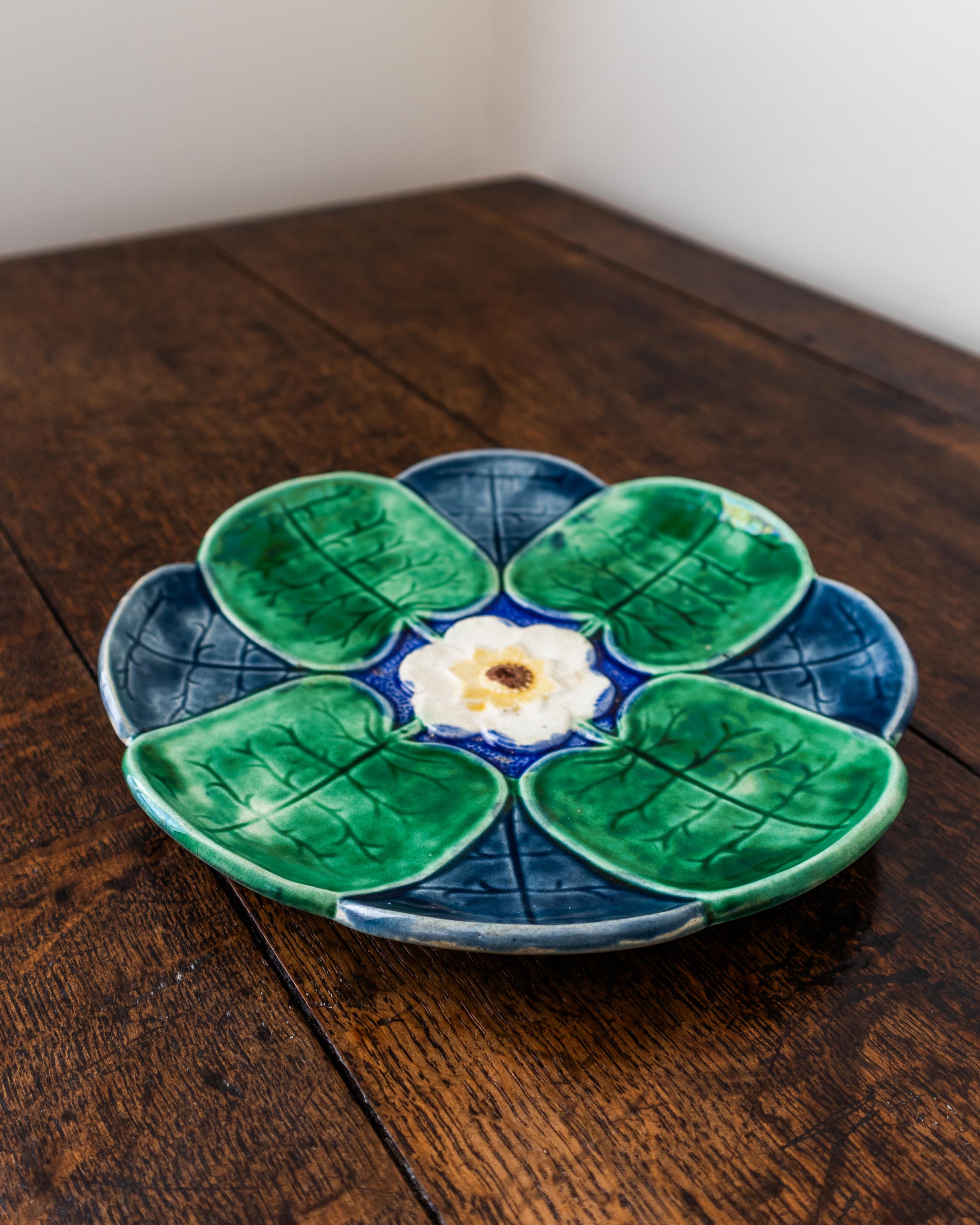
An antique nineteenth century Victorian majolica pond lily plate. The water lily was an especially popular motif for majolica and had many incarnations at the best English makers, such as Minton. It should be little surprise that the water lily made its way to the United States when majolica mania took the US by storm in the 1870s.
Griffen, Smith & Co. created their own version of the plate closely replicating the English models, such as those made by Adam & Bromley, but much more brightly coloured and mostly marked as in this fine and rare example. This plate appears as model D13 in Catalogue of Majolica, Etruscan Works, Griffen Smith & Co., 1884 (see The Gen). It is often referred to as the “pond lily” plate in various reference books and, whilst influenced by the English makers, Griffen, Smith & Co. still stayed close to home for inspiration (see The Gen).
This rare plate has an especially evocative colourway, the deep blue of water accentuating the green of the lily pad leaves around a delightful white and yellow flower, and is truly reflective of the company’s distinctive and highly admired glazes (see The Gen).
DIMENSIONS: Diameter 20.5 cm.
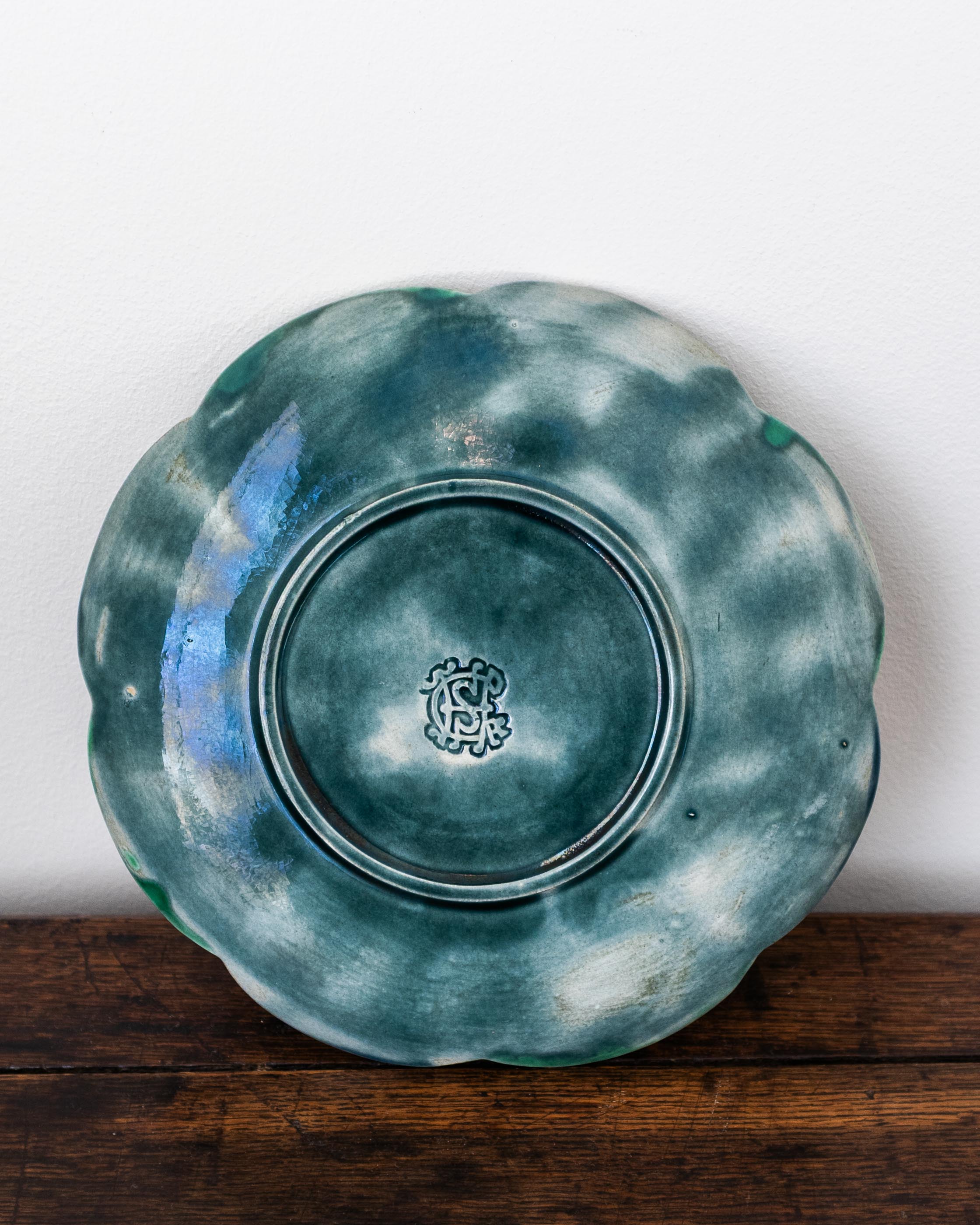
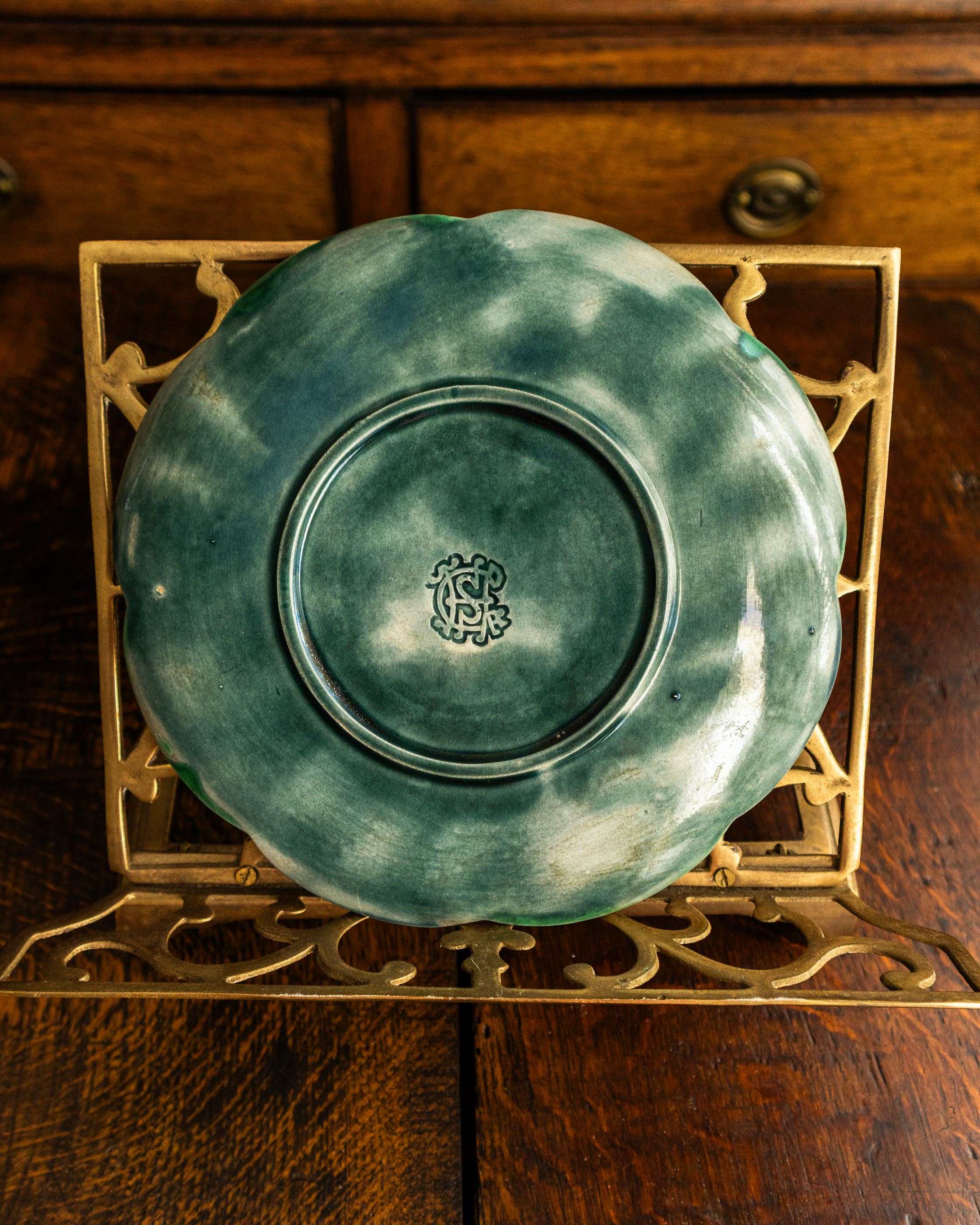
SIGNATURES, MARKINGS & INSCRIPTIONS: Impressed ‘GSH’ monogram.
“To introduce their first line of majolica, the partners decided to impress this earthenware with their initials — GSH. From that day forward, majolica history was written in Phoenixville, Pennsylvania. However, before the first batch of majolica was ready for sale, William Hill, one of the four partners in the firm, withdrew from the organisation. The 1880 census record revealed the name change when it carried the firm’s new title as Griffen, Smith and Company — Stoneware and Earthenware. The new triumvirate, the two Griffen men and David Smith, decided to keep their monogram — GSH — intact, which the firm amusingly referred to thereafter as standing for ‘good, sturdy and handsome’.” (American Majolica 1850–1900, M. Charles Rebert, Wallace-Homestead Book Company, 1981, p. 31)
CONDITION: The plate is in excellent condition with wear consistent with an antique age and use. There is no evident restoration.
REFERENCES: For an example of a similar plate see Majolica: American & European Wares, Jeffrey B. Snyder, Schiffer Publishing Company, 1994, p. 70.
~~~~~~~~~~~
THE GEN
“This publication is one of the few illustrated catalogues of majolica ever released by any manufacturer — British or American. Its eleven pages feature color images of 136 majolica models, each with its own individual letter-and-number shape designation. These identifiers can be cross-referenced with a wholesale price list that includes the corresponding pattern and shape names. The catalogue, produced by Hatch Lithographic Co., a renowned New York printer of the period, is lavishly illustrated, thoughtfully designed, and testament to Griffen, Smith & Co.’s ambition within the US ceramic trade.”
Catalogue of Majolica, Etruscan Works, Griffen Smith & Co., Manufacturing Potters, Phoenixville, Penna. Hatch Lithographic Co., New York, New York, Before 1884, Printed pamphlet, Historical Society of the Phoenixville Area, Pennsylvania. Read this wonderful catalogue here
“Griffen, Smith & Co’s popular pond lily plate. Because each piece was hand-painted, few looked exactly like this portrayal in the 1884 catalog. The quality of the result depended on the skill and experience of each individual artisan. On a typical production day, a skilled master painter or decorator would provide a well-painted example of each of the different pieces as a model for the rest of the painters. These painters copied the model to the best of their abilities with varying results. One of the women who painted glaze decoration for Griffen, Smith and Company in Phoenixville, Pennsylvania recalled: ‘We each had our camel’s hair brush and the little pots of majolica paint sitting before us. We painted the ware blue in order to get a pink; deep rose changed to blue; black would turn out deep brown. I was only eleven years old when I first started working… I was the youngest of the painters and the shortest... Mr Smith didn’t want to hire me, but it was a necessity that prompted me to apply for the job. I used to do roses, carnations, and forget-me-nots’.” (Majolica, American & European Wares, Jeffrey B. Snyder & Leslie Bockol, Schiffer Publishing Ltd, 1994, p. 70)
“Young girls were sent out to search the lanes and roadside banks, especially along Blackrock Road near the village of Oaks. Others searched the meadowlands and woodlands for suitable subjects that might become attractive patterns. What the young girls returned with were sprays of wildflowers and buttercups, fresh oak and maple leaves, pond lilies and sunflowers, ivy tendrils and fern fronds. Each of these subjects was pressed into use and deftly modelled into Etruscan patterns.” (American Majolica 1850–1900, M. Charles Rebert, Wallace-Homestead Book Company, 1981, p. 41)
~~~~~~~~~~~
Would you like to know more about this piece? Email info@georgegen.com.au I would be happy to help.