Late Regency
1837 | England
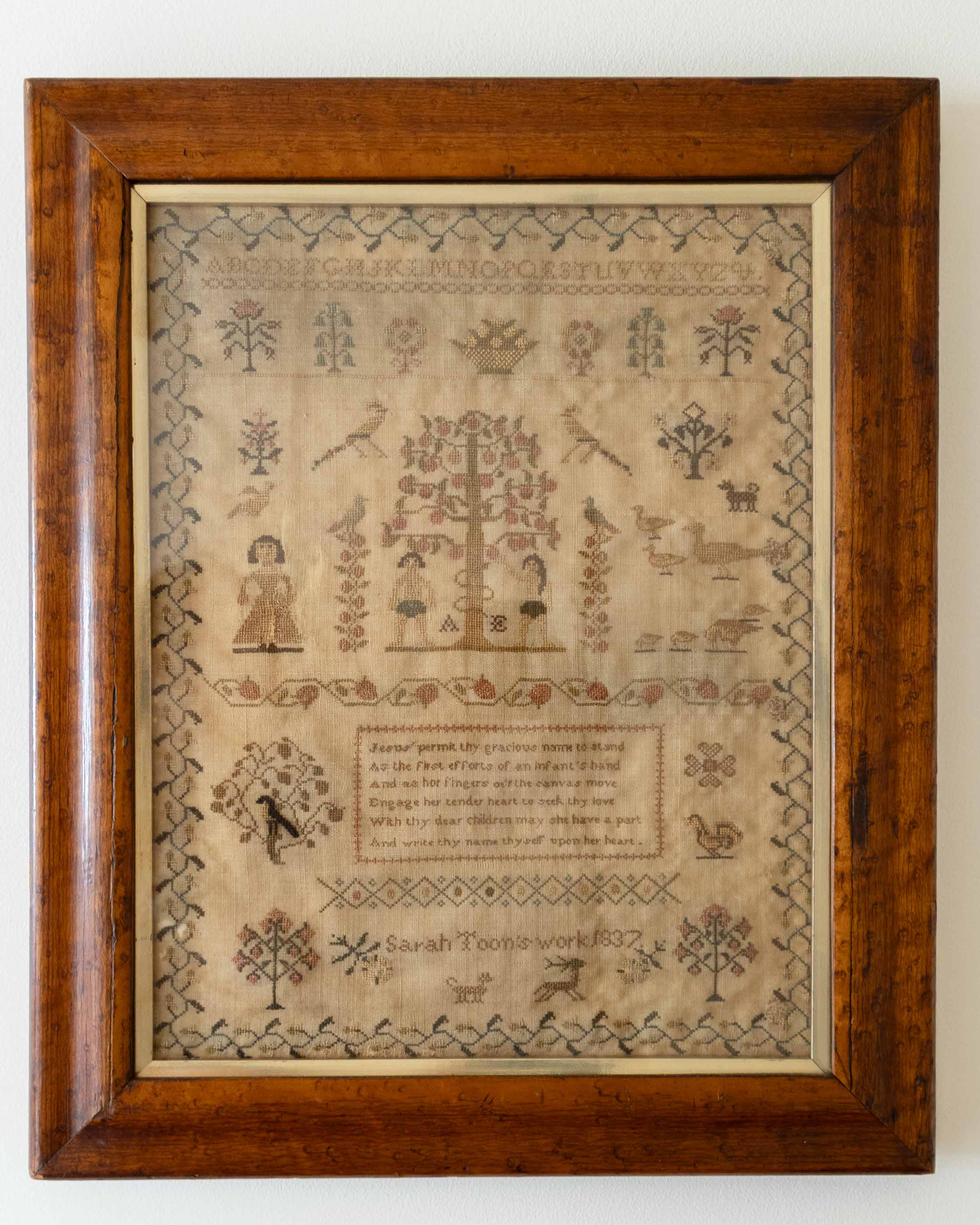
An antique late Regency pictorial sampler with Adam and Eve (see The Gen) worked by Sarah Toon. It was created in 1837, the year of Queen Victoria’s coronation, at the sunset of the Regency era and the dawning of the long Victorian era. It’s inscribed “Sarah Toon’s work 1837”.
Within its scrolling vine border the sampler is filled with a range of motifs including the central motif of Adam and Eve in the Garden of Eden, under the Tree of Knowledge with the serpent. Scattered symmetrically are spot motifs that include birds, flowering plants in pots, trees, dogs, a gaggle of ducks, peacocks, a deer, a lucky four-leaf clover and what charmingly may be a depiction of Sarah herself!
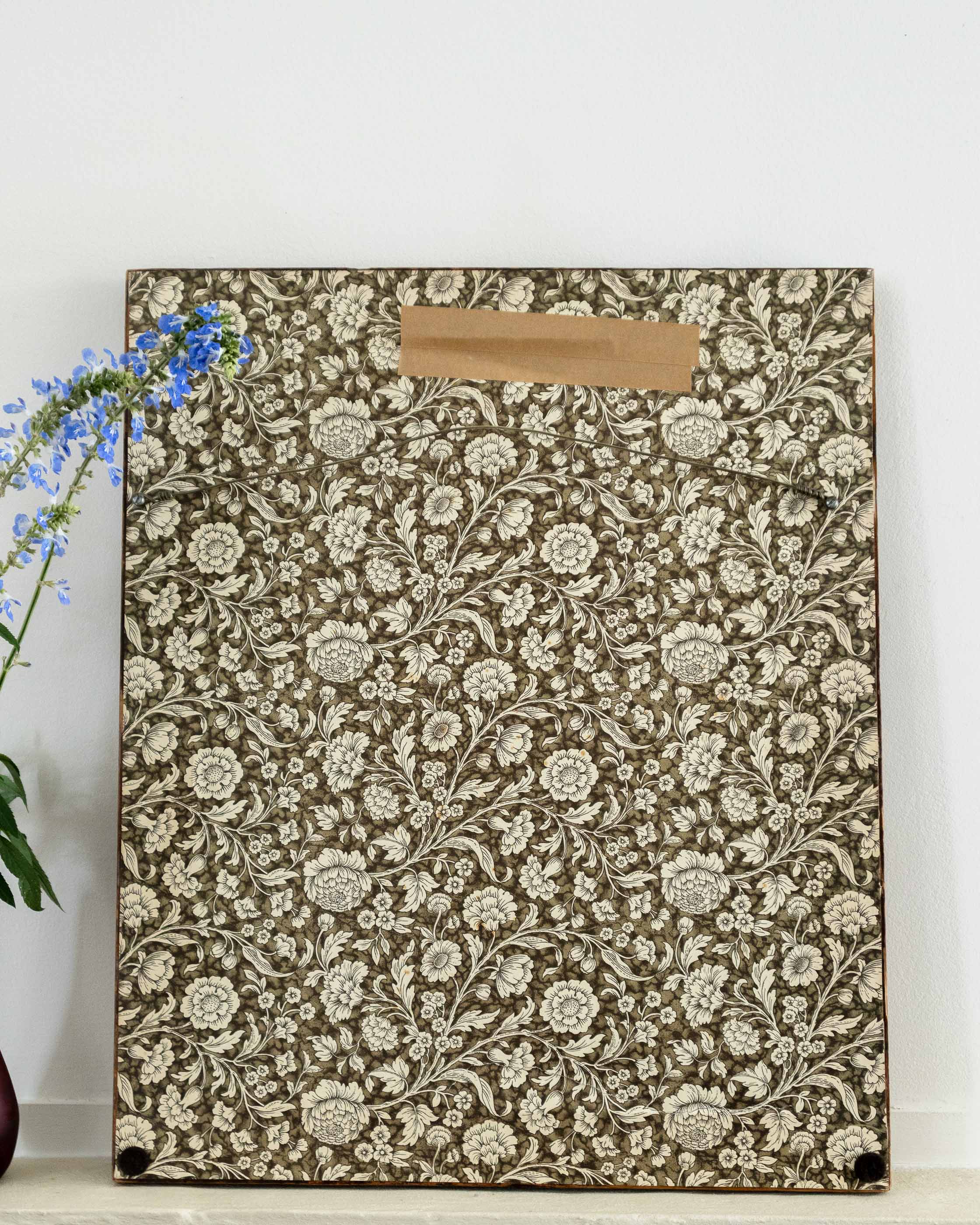
The sampler is embroidered in a range of finely worked stitches in silk on plain weave linen. Conservation framing, including crêpe backing, and likely in a period bird’s-eye maple frame.
SIGNATURES, MARKINGS & INSCRIPTIONS:
Jesus permit thy gracious name to stand,
As the first efforts of an infant’s hand,
And as her fingers off the canvas move,
Engage her tender heart to seek thy love,
With thy dear children may she have a part,
And write thy name thyself upon her heart.
Sarah Toon’s work 1837.
DIMENSIONS: Framed 51 x 42 cm, Visible sampler 39 x 30 cm.
CONDITION: In very good original condition retaining vivid colour. It appears that there were once minor losses/tears which have been treated within the conservation framing.
REFERENCES: For an example of a similar sampler see Victoria & Albert Museum, Accession Number CIRC.7-1914.
~~~~~~~~~~~
THE GEN
“Adam and Eve feature regularly in samplers of the period. There are many variations in the treatment of this subject. In some, Adam and Eve are fully clothed in contemporary costume, in others they are naked but with a generous supply of fig leaves. Occasionally they have clearly been confused with the ‘boxer’ motif, which had virtually disappeared by the end of the eighteenth century. They often stand by a tree of knowledge, heavily laden with apples. The serpent is a popular decorative motif in its own right, partly because it is the animal which lends itself most easily to interlacing. In connection with Adam and Eve it can be a symbol of evil because it is a memory of the Fall, but it can also be a symbol of eternity and The Resurrection because it sheds its skin and emerges afresh.” (Samplers: Five Centuries of a Gentle Craft, Anne Sebba, Weidenfeld and Nicolson, 1979, pp 66–67)
~~~~~~~~~~~
Would you like to know more about this piece?
Make an enquiry via email here.